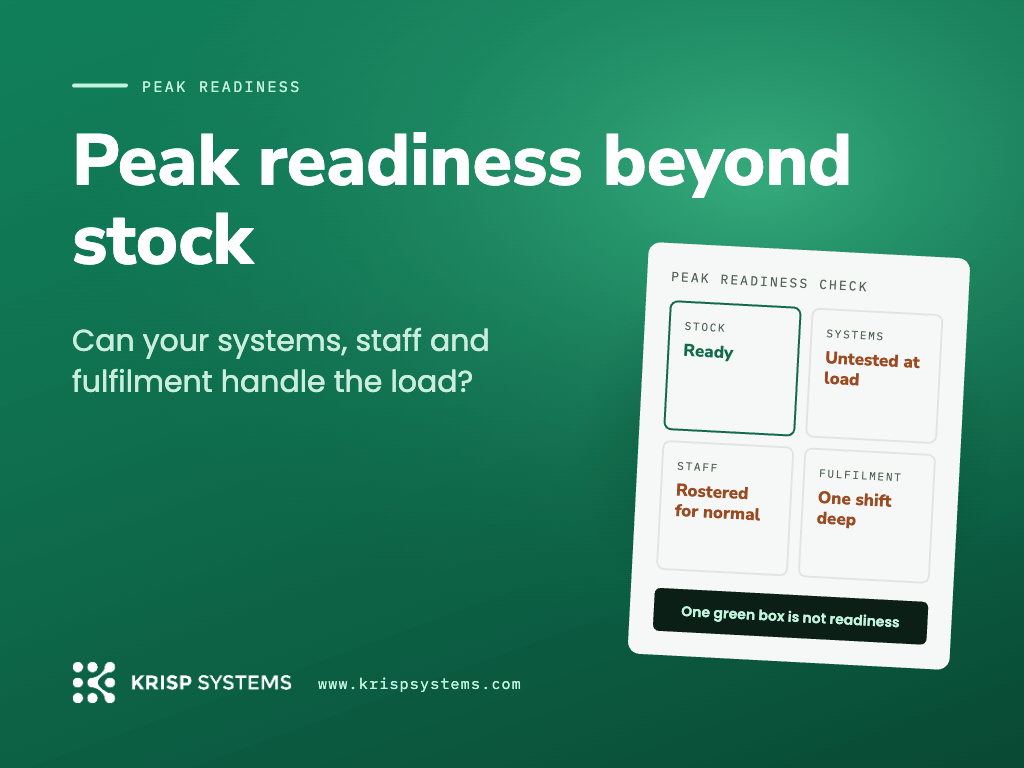
Every peak plan begins with a stock question. Have we ordered enough of the right things, in the right places. It is the right question. It is not the whole one.
For the operations, ecommerce, and IT leaders who carry peak, the failures that hurt most are rarely empty shelves. They are the site that crawls on the biggest sales day, the order that misses Christmas, and the team that cannot clear the queue. You can have every unit you planned for and still lose the sale if the systems, fulfilment, and people around that stock give way under the load.
That is what real peak readiness is about. Peak does not test your stock. It tests everything around it.
Peak is bigger and more concentrated than ever
The stakes are not subtle. In 2025, the Australian Retailers Association and Roy Morgan tipped Australians to spend a record $6.8 billion over the four-day Black Friday to Cyber Monday weekend, with around 6 million people taking part. The ARA has also noted that many discretionary retailers make up to two-thirds of their annual profit in the peak season.
A huge share of the year’s result now lands in a few weeks, and increasingly in a few days. The shorter the window, the more it costs when anything inside it fails.
Stock is table stakes. Load is the real test.
Having the stock is the price of entry. What peak actually tests is whether everything around it can cope when volume spikes.
| What peak tests | What the load does to it | What it costs when it fails |
|---|---|---|
| Systems (site, app, POS) | Traffic and transactions surge well above normal | Slowdowns and crashes at the highest-revenue moment |
| Fulfilment | Order volume outruns picking, packing, and delivery capacity | Late or failed deliveries, and promises broken at Christmas |
| Store teams | More customers and more orders, often with no more hands | Slower service, errors, and stock questions left unanswered |
A retailer can pass the stock test and still fail any of these three.
These failures hit hardest when volume is highest, which is exactly when a retailer can least afford them.
When the system goes down, so does the sale
The most visible failure is a system that cannot take the load. Independent research firm ITIC found that a single hour of downtime costs more than US$300,000 for over 90% of mid-size and large enterprises. At peak, that figure is conservative, because an hour of downtime on Black Friday is the most valuable hour of the year.
A surge in traffic is a classic trigger for an outage, and peak is one long surge. A checkout that runs fine in October can fall over in the first hour of a major sale, and the customers it turns away do not wait around. They buy somewhere that stayed up.
Fulfilment is where the promise is kept or broken
The next test comes after the sale. The scale is enormous: Australia Post delivered more than 110 million parcels across November and December in its most recent peak, and handled 3.3 million on its busiest single day.
Every order is a promise with a deadline, and many are gifts with no room to move. When fulfilment cannot keep up, or an order routes to a store that is already overwhelmed, the failure lands at the worst moment. A late Christmas delivery is not a logistics footnote. It is a customer lost, often for good.
The same peak, two operations
The difference between a peak that holds and one that breaks shows up in the same moments, decided by whether operations are connected and ready.
| The moment | When operations are connected and ready | When they are not |
|---|---|---|
| Traffic spikes on the first morning of the sale | The site scales and the checkout stays fast | It slows or crashes at the peak hour and customers leave |
| An online order needs fulfilling from a store | It routes to a store that can actually complete it | It lands on a store already overwhelmed, and is cancelled |
| A customer asks about stock across stores in the rush | The team confirms and acts in seconds | No one can check, and the customer walks |
| Returns flood in after peak | They reconcile to inventory automatically | They pile up as phantom stock and stall January |
Same peak, same customer. The operation behind the moment decides the outcome.
Peak is a stress test of connected operations
Peak does not create new problems. It magnifies the ones already there. A small gap between systems, survivable in a quiet week, becomes a queue, a crash, or a broken promise under load.
So peak readiness is really a test of how connected your operations are. Krisp Systems helps retailers connect POS, orders, inventory, and fulfilment into one operational view, so stock, orders, and fulfilment stay in step when volume spikes, and stores and head office work from the same picture on the busiest days of the year. The stock plan gets you to the start line. A connected operation carries it through.
And then the returns come
Peak does not end when the sales stop. It ends weeks later, once the returns are processed. The National Retail Federation and Happy Returns put US returns at US$890 billion in 2024, with holiday return rates about 17% above the annual average. If those returns cannot be reconciled to inventory quickly, the stock you fought to sell in December becomes stock you cannot see, or resell, in January.
Four questions to pressure-test your peak readiness
Stock aside, these are the questions that decide how peak actually goes:
- Systems: if traffic triples on the first morning, does the site and checkout stay fast, or fall over at the peak hour?
- Fulfilment: can orders route to locations that can genuinely complete them, or do they pile onto whoever is already busiest?
- Teams: can an associate answer a stock or order question in seconds during the rush, or not at all?
- Returns: when the post-peak returns arrive, do they reconcile to inventory automatically, or become stock you cannot see?
If any answer is uncertain, that is where peak will test you first.
The practical takeaway
Plan the stock, of course. But the outcome of peak is decided by whether your systems can take the load, your fulfilment can keep its promises, and your teams can cope, all at once, on the busiest days of the year.
Peak rewards the retailer who prepared the whole operation, not just the shelves.
FAQs
What is peak readiness in retail?
It is being prepared for the surge in trading around events like Black Friday, Cyber Monday, and Christmas. It covers not just stock levels but whether systems, fulfilment, and store teams can handle the spike in volume.
Why is stock not enough for peak?
Because the costliest peak failures are usually operational, not empty shelves. A site crash, an overwhelmed fulfilment network, or a stretched team can lose sales even when the stock is there.
What causes systems to fail during peak?
Usually the surge in traffic and transactions. ITIC found downtime costs most large enterprises over US$300,000 an hour, and a traffic surge is a classic trigger, so peak is exactly when systems are most likely to fall over.
How does fulfilment affect peak performance?
Peak concentrates a huge volume of time-sensitive orders. If fulfilment cannot keep up or orders are routed poorly, deliveries run late, which is especially damaging around Christmas.
How can retailers prepare their operations for peak?
By connecting the systems that run peak, so stock, orders, and fulfilment stay in step under load and teams work from one view. Connected operations are what let a retailer absorb the surge without breaking.
Want your systems, stores, and fulfilment ready for the load, not just your shelves? Talk to Krisp Systems about connecting POS, inventory, orders, and fulfilment into one operational view.