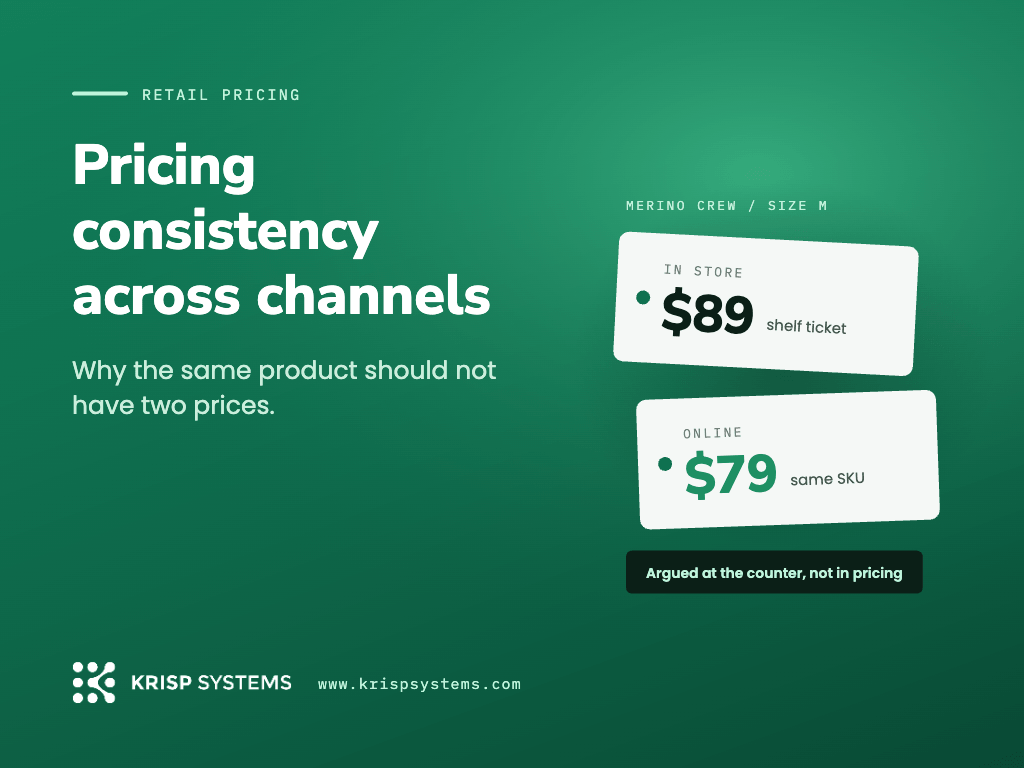
Every customer now walks in with a price-checker in their pocket. They stand in the aisle, look at the ticket, and open your app or your website to compare before they decide. The shelf price is no longer the only price they see. It is one of several, and they expect all of them to agree.
When they do not, the customer notices immediately. A price that is different depending on where you look does not read as a small admin slip. It reads as either a mistake or a trick, and both cost you.
The customer is already checking
This is not a hypothetical. Retail research firm 1WorldSync found that 72% of North American adults use their smartphone to compare prices while shopping in-store, making it the single most common in-store phone activity. PYMNTS Intelligence reports the behaviour is still climbing, with in-store phone use rising to 42% of shoppers in 2026, up from 30% in early 2024.
So the mismatch you might never have caught internally is now caught in real time, by the customer, at the shelf. The gap between your channels is visible to the one person you least want to see it.
A mismatch is a trust problem
The reaction is not mild. Forrester found that 60% of consumers would likely stop shopping with a company if they discovered it charged different prices in different channels for the same product.
That is the real cost of inconsistent pricing. It is not the value of one disputed transaction. It is the customer quietly deciding you cannot be trusted on price, which is one of the few things they can check for themselves in seconds. Once that trust goes, they check every price you show them, or they stop showing up.
The same price, two outcomes
of truth or several.
| The moment | When price is one source of truth | When channels disagree |
|---|---|---|
| A shopper checks your app in the aisle | The app matches the shelf, and they buy with confidence | The app is cheaper, so the shelf price feels like a markup and they hesitate |
| A promotion ends overnight | The new price applies everywhere at once | The website updates but the till still rings the old price, or the reverse |
| An item scans at the checkout | The scanned price matches the ticket | It scans higher than the shelf, and a dispute begins |
| A price is advertised online | The store can see it and honour it | Staff cannot see the online price, so they cannot match it |
Same product, same customer. What separates a confident sale from a dispute is whether the systems behind each price agree.
In Australia, it is also a compliance issue
For Australian retailers, price inconsistency is not only a trust risk. It carries obligations.
| Rule | What it means for retailers |
|---|---|
| Multiple pricing (Australian Consumer Law) | If more than one price is displayed for the same item, you must sell it at the lowest displayed price, or withdraw it until the discrepancy is fixed |
| Scanning Code of Practice (voluntary; signatories include Coles, Woolworths, Aldi, some IGA) | If an item scans above the shelf price, the first one is free and any extras are charged at the lower price |
Sources: CHOICE (2024), Australian Consumer Law.
A price that disagrees with itself can move from an awkward moment at the counter to a refund, a free item, or a compliance problem. The scanning code turns a data gap into a direct cost.
Why prices drift apart
Few retailers set out to show two prices. It happens because a price does not live in one place. It sits in the POS at the shelf, in the ecommerce platform online, in the app, and in whatever runs promotions. Each has its own timing.
When those systems are not connected, a price change or a promotion has to be made in several places and take effect at the same moment, which it rarely does. A promotion starts online before the store catches up. A price rise lands at the till before the website reflects it. The customer standing in the aisle sees both.
Pricing is a margin lever too
There is a commercial edge to getting this right beyond avoiding disputes. McKinsey’s long-established pricing analysis found that a 1% change in average price can move operating profit by around 8%, assuming volumes hold. Price is one of the most sensitive levers a retailer has. Managing it through disconnected systems, where the actual price charged is not fully under control, puts that lever at risk in both directions.
One price, one source of truth
The fix is not more discipline at each channel. It is a single, connected view of price.
Krisp Systems helps retailers connect POS, orders, inventory, and pricing into one operational view, so the price a customer sees at the shelf, at the till, and across channels is drawn from the same source. A change made once takes effect consistently, and store teams can see the price the rest of the business is showing. The goal is simple to state and hard to fake: one product, one price, wherever the customer looks.
The practical takeaway
Your customers are already comparing your prices across channels, in real time, from the aisle. The only question is whether they find agreement or a contradiction.
Consistent pricing is not a presentation problem to be smoothed over with a price-match policy. It is a systems problem, solved by connecting the places a price lives so it only ever tells one story. Get that right and price stops being a risk at the counter and goes back to being a lever you control.
FAQs
Why do retailers show different prices across channels?
Usually because price lives in several disconnected systems, the POS, the website, the app, and a promotions engine, each with its own timing. When a change is not applied everywhere at once, the channels disagree.
How does inconsistent pricing affect customers?
It erodes trust. Forrester found 60% of consumers would likely stop shopping with a company that charged different prices in different channels for the same product, and many now check prices on their phones in-store.
What are the rules on pricing in Australia?
Under the Australian Consumer Law’s multiple-pricing rule, a business must sell an item at the lowest displayed price if more than one is shown. Under the voluntary Scanning Code of Practice, an item that scans above the shelf price is given free for the first unit.
Is a price-match policy enough?
It helps at the moment of complaint, but it treats the symptom. Consistent pricing across channels addresses the cause, so the mismatch does not happen in the first place.
How can retailers keep prices consistent?
By connecting the systems where price lives, so a change is made once and applied everywhere at the same time, and store teams can see the same price the rest of the business is showing.
Want one price that is right everywhere your customers look? Talk to Krisp Systems about connecting POS, inventory, orders, and pricing into one operational view.