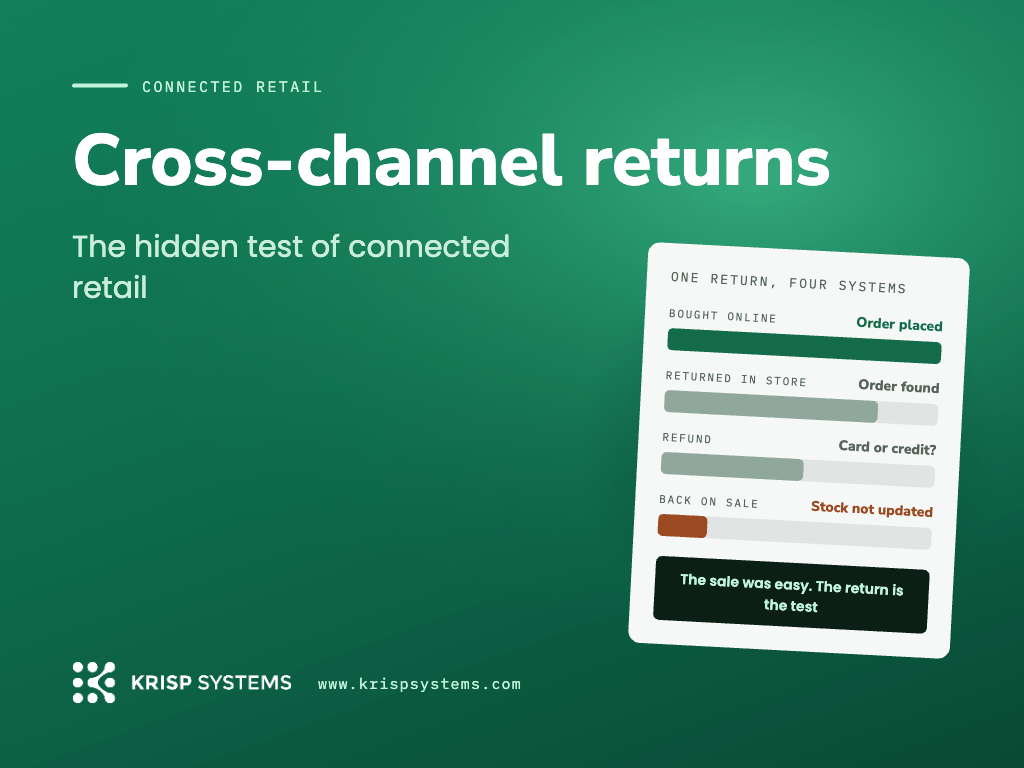
A shopper walks into your store holding something they bought on your website. They want to hand it back and get their money. To them it is simple. Behind the counter, it is one of the harder things in retail to get right.
That return has to travel back through three systems, the online order, the store POS, and inventory, and land as accurate, sellable stock. When they do not line up, the refund goes out but the item does not truly come back, at least not anywhere the business can see. It becomes phantom stock: paid for, handled, and invisible. For a part of retail that already runs on thin margins, that is an expensive place to lose track of your own goods.
Returns are the most common moment where a sale crosses channels, and the clearest test of whether those channels are actually connected.
Returns are big, mostly online, and mostly come back to a store
Returns are not a rounding error. The National Retail Federation’s 2025 Retail Returns Landscape put total US retail returns at US$849.9 billion, about 15.8% of sales, with 19.3% of online sales returned, well above the all-retail rate.
| Metric (2025) | Figure |
|---|---|
| Total US retail returns | US$849.9 billion |
| Share of annual sales returned | 15.8% |
| Share of online sales returned | 19.3% |
| Returns that are fraudulent | 9% |
And online returns do not go back the way they came. Most are handed back in a physical store, a pattern known as BORIS, buy online, return in store. The returns-software firm Optoro found 67% of shoppers prefer to return online orders to a store, and aggregated industry data puts the in-store share of e-commerce returns close to 60%. The channel that made the sale is usually not the channel that takes it back, and that hand-off is where the trouble starts.
The cost sits in the margin
Returns are expensive even when they go smoothly. Analysis by CBRE, cited by Optoro, found that processing a return costs around 27% of an item’s purchase price and can erase up to half of the sale’s margin. For finance and operations teams, that makes returns a margin problem, not just a logistics one.
A cross-channel return that cannot be reconciled is worse still. The retailer has paid to acquire the customer, shipped the order, refunded the money, and handled the item, and at the end the stock is sitting in a back room no system can see. The same line can sell out online while those units sit idle in a store, so the business reorders goods it already owns. That is phantom stock doing its quiet damage.
The same return, two outcomes
Whether a return recovers value or leaks it comes down to whether the channels are connected.
| The moment | When returns are connected | When they are not |
|---|---|---|
| A customer returns an online order in-store | It is recognised, refunded, and back in sellable stock in one step | The refund goes out, but the item sits in limbo, unseen by inventory |
| The returned item is in demand elsewhere | It is visible across the network and resold or transferred quickly | It waits in a back room while the same line sells out online |
| A serial returner works across channels | The pattern is visible and can be flagged | Each channel sees only its slice, so abuse goes unnoticed |
| A customer checks their refund status | Consistent across app, store, and web | Different answers depending on who they ask |
Cross-channel returns are a fraud gap too
The channel crossing is also where fraud slips through. The NRF found 9% of all returns are fraudulent, and aggregated industry data suggests online purchases returned in-store are riskier, with around 12.7% estimated to be fraudulent. The reason is structural. When the online order system and the store POS do not share a live view, neither sees the full history, so a return that looks fine at the counter may be the fourth time that item has been bought and sent back. Connected data is what turns isolated slices into a visible pattern.
What Australian shoppers expect
Returns also shape where people shop. Loop’s returns research, reported by Power Retail, found that 70% of Australian shoppers rank free return shipping as the most important part of the process, and that around three-quarters are unlikely to shop with a retailer again after a bad returns experience.
So a clumsy cross-channel return does not just cost the margin on that item. It can cost the customer. The refund that takes too long, or the store that cannot find the online order, is remembered the next time that shopper decides where to buy.
Returns are a recovery problem, not just a cost
The retailers who handle returns well treat them as a chance to recover value and keep the customer, not just a cost to absorb. That only works when the return reconnects to the business in real time.
Krisp Systems helps retailers connect POS, orders, inventory, and fulfilment into one operational view, so a return taken in any channel is recognised against the original order, refunded consistently, and put back into one accurate, sellable stock position. The returned item stops being phantom stock and becomes inventory the business can see and sell again.
Four questions to test your returns
A connected returns process should be able to answer yes to all of these:
- Recognition: can a return in any channel be matched to the original order automatically?
- Refund: is the refund consistent across store, app, and web?
- Restock: does the item go back into one accurate, sellable stock position quickly?
- Pattern: can repeat or cross-channel abuse be seen across channels, not just one at a time?
If any answer is no, that is where returns are quietly costing you.
The practical takeaway
Returns are the part of retail most likely to cross channels, and the part most likely to expose whether those channels are connected. When they are, a return is logged, refunded, and resold without friction. When they are not, the money goes out, the item disappears from view, and the customer remembers the hassle.
Getting returns right is not about tightening the policy. It is about connecting the systems so that a return, wherever it lands, finds its way home.
FAQs
What are cross-channel returns?
Returns where the channel that takes the return differs from the one that made the sale, most often an online order returned to a physical store, known as BORIS (buy online, return in store).
What is phantom stock in returns?
A returned item that has been refunded but not reconciled back into the sellable inventory count. The business owns it but cannot see or resell it, so it may reorder stock it already has.
How big is the retail returns problem?
The NRF estimated US retail returns at US$849.9 billion in 2025, about 15.8% of sales, with 19.3% of online sales returned and 9% of returns fraudulent.
Why are cross-channel returns a fraud risk?
Because the online order system and the store POS often do not share a live view. Without the full history, a return that looks legitimate at the counter may be part of a repeated pattern no single channel can see.
How can retailers improve cross-channel returns?
By connecting POS, orders, and inventory so a return in any channel is matched to the original order, refunded consistently, and returned to one accurate stock position quickly.
Want returns to come back as sellable stock, not phantom inventory? Talk to Krisp Systems about connecting POS, inventory, orders, and fulfilment into one operational view.