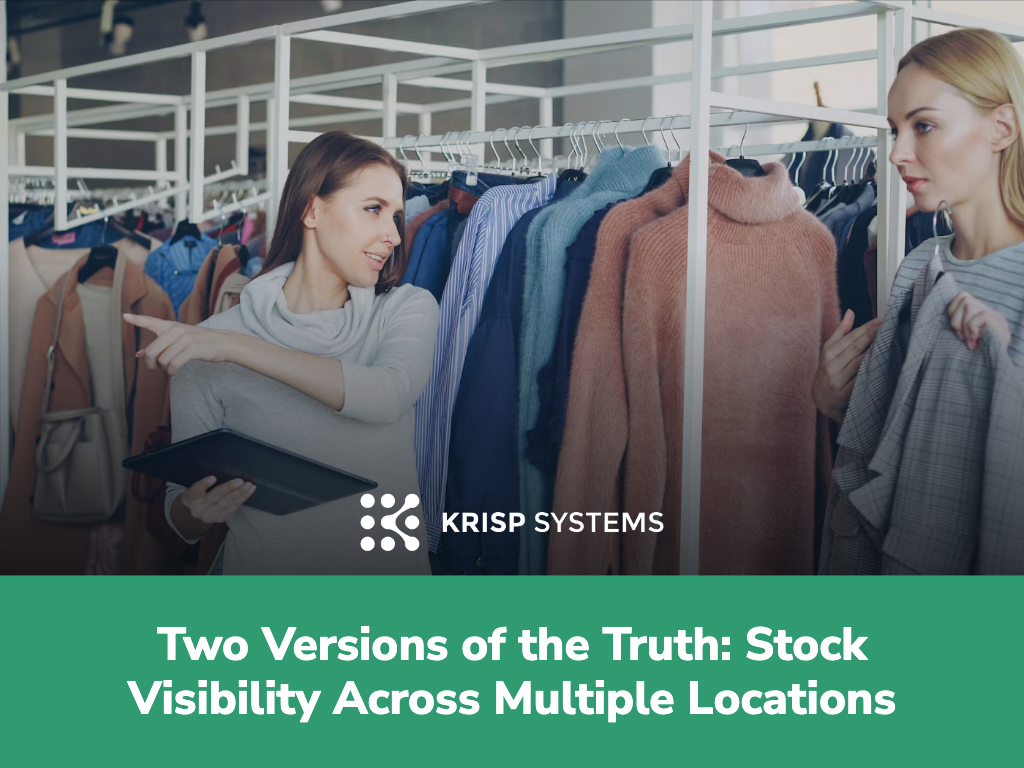
Ask three stores whether an item is in stock and you can get three answers. One says yes, one says no, and one is not sure and offers to check out the back. All three are looking at the same business, and none of them is quite right.
In a single store, stock is a fact you can walk over and confirm. Across a network of stores, warehouses, and channels, it becomes a question of which system you ask and when. The stock exists somewhere. What is missing is one version of the truth that everyone can rely on.
Where the versions diverge
The gap usually opens between head office and the shop floor.
Head office plans, buys, and allocates from one view of stock. The store team serves customers from another, based on what they can see on their own screens and shelves. When those two views do not match, both sides are working from a version of the truth rather than the truth. A promotion is planned against stock that has already moved. A store promises an item that head office has committed to an online order. Neither party is careless. They are simply looking at different views.
No single location can see the full position, and the space between them is where the answers stop lining up.
Transfers and allocation make it worse
The more stock moves, the harder the single view becomes.
Transfers between stores, replenishment from a warehouse, and online allocations all put stock in motion. At any moment a unit might be on a shelf, in transit, committed to an order, or being counted back in from a return. If the systems tracking those states do not update each other in step, the recorded position lags behind reality in one location and runs ahead in another.
This is why a line can look available in the system, sold in the store, and in transit to a third location all at once. The stock is real. The picture of it is fragmented.
What the gap costs
Working from the wrong version of the truth has a predictable set of costs.
Teams make decisions on numbers that have already changed. A store commits to a customer, then cannot deliver because the stock was already spoken for. A transfer that would have balanced two stores never happens, because no one could see the imbalance clearly. And when the position cannot be trusted, buyers do what buyers do under uncertainty, which is order more to be safe.
Zebra found that 84% of retail decision-makers say maintaining real-time visibility of stock levels is a challenge, in its 2024 Annual Global Shopper Study. In a single store that challenge is manageable. Across a network, it is where the wrong version of the truth quietly drives the wrong call.
Why one number is so hard across locations
The difficulty is structural, not a matter of effort.
The point of sale records what happens in each store. The order management layer handles how orders move and where they are fulfilled. Inventory sits across both, and stock adjustments, transfers, and returns move through their own paths. In a single site, these gaps are small and quick to reconcile. Across dozens of locations and several channels, the same gaps compound, and no single screen ever holds the whole position at once.
That is the real problem behind three stores giving three answers. It is not that any of them is wrong. It is that none of them can see the whole.
One view across the network
A trusted answer comes from one shared view, not from reconciling several after the fact.
Krisp Systems helps retailers connect POS, orders, inventory, and fulfilment into one operational view, so store teams and head office can see what is available, what is committed, and what is in transit across the network. When both sides work from the same position, the three-answer problem goes away. A store can confirm stock in another location, head office can plan against a position that reflects reality, and a transfer can be made because the imbalance is finally visible.
The aim is not more reporting. It is one number that everyone, from the floor to head office, can act on with confidence.
The payoff of getting it right
Closing this gap is not only about avoiding mistakes. It tracks with growth.
Manhattan Associates found that only 7% of retailers have reached true unified commerce leadership, and that those leaders grow at nearly twice the rate of the rest, at a time when more than 66% of consumers use two or more channels before they buy. Customers already move across stores and channels as if they were one. The retailers pulling ahead are the ones whose systems finally do the same.
The practical takeaway
If your stores can give different answers to the same stock question, the issue is not the teams. It is that no one is working from a shared view.
In multi-location retail, one trusted position is worth more than more stock. It lets head office and the floor plan and serve from the same numbers, balance stock across sites, and stop making confident decisions on figures that have already moved. The businesses that get there are not just more accurate. They are the ones customers experience as a single, reliable brand wherever they shop.
FAQs
Why do different stores show different stock levels for the same item?
Because each store and channel often works from its own system, and those systems do not always update each other in step. Sales, transfers, online allocations, and returns move at different speeds, so the recorded position drifts between locations.
What is a single view of inventory?
It is one shared, real-time position of stock across all stores, warehouses, and channels, showing what is available, what is committed, and what is in transit. It lets head office and store teams act on the same numbers.
Why is stock visibility harder for multi-location retailers?
Because every extra location and channel adds another partial view to reconcile. Small timing gaps that are trivial in one store compound across a network, so the same question can return different answers.
How do stock transfers affect inventory accuracy?
Stock in transit sits between locations, counted in neither until it is received. If transfers are not tracked in real time across systems, the position looks wrong at both the sending and receiving ends.
How can retailers get one trusted stock position?
By connecting POS, orders, inventory, and fulfilment into one operational view, so every location and channel updates the same position rather than holding its own.
Want head office and every store working from the same stock position? Talk to Krisp Systems about connecting POS, inventory, orders, and fulfilment into one operational view.