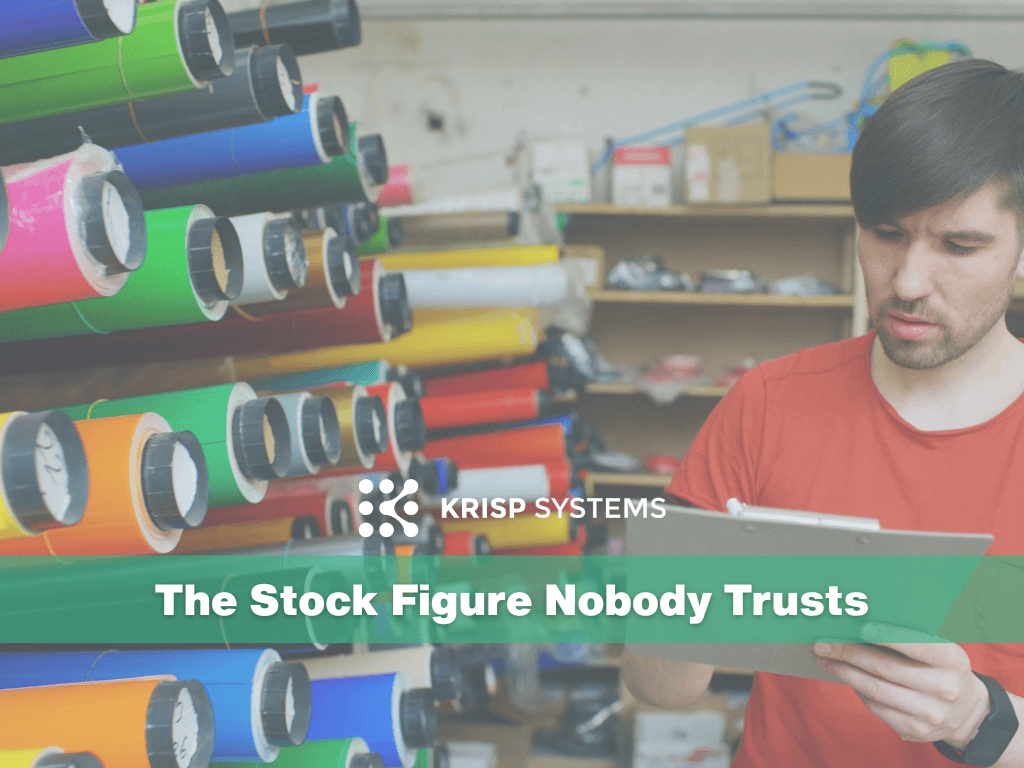
A stock number that no one believes is worse than no number at all. A blank prompts someone to go and check. A wrong number prompts a workaround, and workarounds are where the cost hides.
Most retailers do not set out to distrust their own data. It happens slowly. The figure is right often enough to look fine, but wrong often enough that the team learns to hedge. Once that happens, the number on the screen stops driving decisions, and the people around it start managing by instinct instead.
When the number stops being believed
Trust in a stock figure is quiet until it breaks. A team confirms an item is available, a customer arrives, and it is not there. It happens again a week later with a different product. Nobody logs it as a failure, but the lesson lands. The next time someone is asked whether an item is in stock, they add a silent caveat to their answer.
From that point, the figure is treated as a rough guide rather than a fact. That single shift changes how the whole store operates.
What an untrusted number does to a team
When people cannot rely on the figure, they protect themselves in predictable ways.
They give cautious answers, because it is safer to say they will check than to promise something they cannot confirm. They make phone calls to other stores rather than trust the on-screen count. They round down when quoting availability, to avoid being caught short. And when ordering, they add a little extra, because holding too much feels less risky than running out.
None of this is carelessness. It is a rational response to a number that has let them down before. But each workaround adds time, and together they pull the team away from serving customers and towards managing around the system.
The two costs hiding in one problem
An untrusted figure is expensive in two directions at once.
On one side, it costs sales. A cautious answer or an unconfirmed availability check gives the customer a reason to hesitate, and a hesitating customer often leaves. The stock may have been there the whole time. It was the lack of confidence, not the lack of product, that lost the sale.
On the other side, it costs margin. When buyers cannot trust the position across locations, they order to be safe. That extra stock ties up cash, sits in the wrong place, and often ends in markdown. The same untrusted number that empties one shelf quietly overfills another.
Why the number drifts
The figure drifts because the systems behind it do not share one version of events.
The point of sale records what happens in the store, including sales, returns, and exchanges. The order management layer handles orders and fulfilment. Stock adjustments, transfers, and online allocations move through their own paths. When these do not update each other in step, the count on the screen lags behind reality. It is not that anyone entered the wrong figure. It is that no single figure ever saw the whole picture.
For multi-location retailers, the drift compounds. Each store and channel holds part of the truth, and the gaps between them are where confidence leaks away.
Turning a number into something teams act on
stock figure only earns trust when it reflects what is actually happening across the business.
Krisp Systems helps retailers connect POS, orders, inventory, and fulfilment into one operational view, so store teams and head office can see what is available, what is pending, and what needs action. The point is not a prettier dashboard. It is that the figure a team acts on is drawn from the same connected picture, so the count on the screen and the stock on the floor stay closer together.
When the number can be trusted, the workarounds fall away. Teams answer with confidence instead of hedging. Buyers order to real demand rather than to a safety margin. The figure goes back to doing its job, which is to help people decide.
The practical takeaway
If your teams quietly work around the stock figure, the problem is not the people. It is that the number has not earned their trust.
Inventory accuracy is often measured as a percentage, but its real value is behavioural. A figure people believe gets acted on. A figure they doubt gets managed around, and that costs you sales at one end and margin at the other. Connecting the systems behind the number is what turns it back into something worth trusting.
FAQs
What does inventory accuracy actually mean?
It is how closely your recorded stock matches what is physically available, across stores and channels. High accuracy means the figure on the screen can be acted on without a manual check.
Why do store teams stop trusting stock figures?
Usually because the figure has been wrong at the wrong moment more than once. After that, teams hedge their answers and verify manually, even when the number happens to be right.
How does an untrusted stock figure cost money?
In two directions. It loses sales when teams give cautious or unconfirmed answers, and it adds cost when buyers over-order to stay safe, which ties up cash and leads to markdowns.
Why does stock data drift out of accuracy?
Because sales, returns, transfers, online orders, and adjustments often move through separate systems. When those systems do not update each other in step, the recorded figure falls behind what is really on hand.
How can retailers make stock figures more reliable?
By connecting POS, orders, inventory, and fulfilment so the figure reflects one shared view of activity, rather than several systems each holding part of the picture.
Want your teams to trust the stock figure they act on every day? Talk to Krisp Systems about connecting POS, inventory, orders, and fulfilment into one operational view.