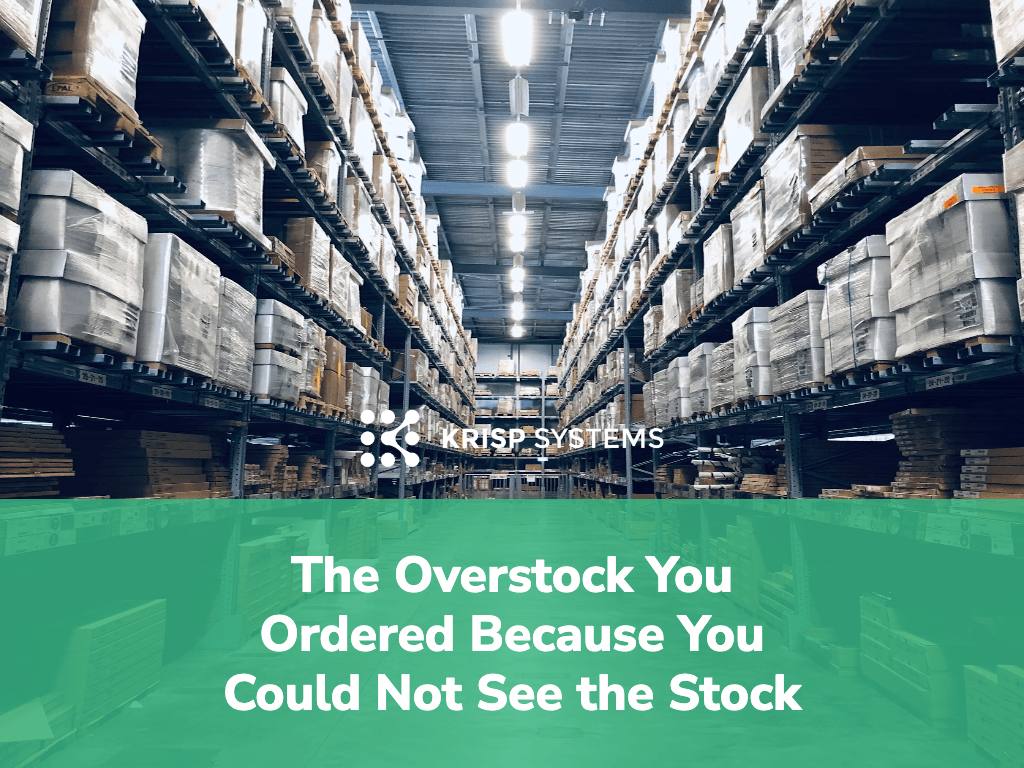
Overstock rarely looks like a mistake at the time. It looks like caution. A buyer is not sure how much is really on hand across the network, so they round the order up to be safe. Months later that caution is sitting in a back room as excess stock, waiting for a markdown.
Out-of-stocks get most of the attention in retail, because an empty shelf is visible and a lost sale stings. Overstock is quieter, and the numbers behind it are large. It is the same problem seen from the other side, and it usually starts with the same cause.
The overstock half is bigger than it looks
Inventory distortion is the combined cost of getting stock wrong in both directions. IHL Group estimated in September 2025 that it costs global retail around US$1.73 trillion a year, about 6.5% of retail sales, split between out-of-stocks and overstocks.
The overstock share is substantial. In IHL’s earlier 2023 analysis, overstock alone accounted for about US$562 billion, the excess inventory that ends in heavy discounting or spoilage. The scale is easy to see at country level too. McKinsey reported that US retailers were sitting on roughly US$740 billion in unsold goods, after inventories rose around 12%, or US$78 billion, over the course of 2022.
Those are not abstract totals. They are cash locked in product that is not selling, and margin that will not be fully recovered.
The money is tied up long before the markdown
Overstock costs the business well before anything reaches the discount rack.
US retailers held an inventories-to-sales ratio of 1.25 in May 2026, according to the US Census Bureau. In plain terms, that is roughly 1.25 months of sales sitting as stock at any given time. Some of that is necessary. The portion that is not is working capital the business cannot use.
Holding that stock is not free either. A widely cited industry benchmark puts inventory carrying cost at 20% to 30% of the stock’s value each year, once storage, handling, insurance, and the risk of obsolescence are counted. Overstock quietly runs up that meter every month it sits.
Why buyers over-order
Few buyers set out to over-order. They do it because the alternative feels worse.
When the stock position across stores and channels cannot be trusted, ordering becomes a hedge. If the figure might be wrong, ordering a little extra feels safer than risking an empty shelf during a promotion. That instinct is rational for a single order. Repeated across a season and across locations, it builds a stockpile.
Safety stock has a place. But there is a difference between safety stock based on real demand and a buffer added to cover for data the team does not believe. The first is planning. The second is insurance against poor visibility, and the figures above are what it costs.
Where the cost finally lands
Excess stock that does not move at full price moves at a discount, and the discount is where the margin goes.
McKinsey has estimated that better markdown management can lift margin rates by 400 to 800 basis points. That is a useful signal in both directions. It shows how much margin is tied up in how excess stock is cleared, and it hints at how much was lost by ordering that excess in the first place. The best markdown is the one you never had to take, because the stock was never over-ordered.
The imbalance makes it worse. A line can be overstocked in three stores and short in two others at the same time, so the business holds too much and too little of the same product at once. Without a clear view across locations, that is almost impossible to correct through a transfer, so both problems get solved with more buying.
It is a visibility problem, not a buying problem
It is tempting to treat overstock as a buying discipline issue. More often it is a visibility issue that shows up at the buying desk.
The true position of a product is spread across systems. The point of sale holds what has sold, the order management layer holds what is on the way and what is committed, and stock adjustments, transfers, and returns move through their own paths. When these do not reconcile into one view, no one sees the real available position clearly. The buyer works from a partial picture, adds a margin for the parts they cannot see, and the overstock follows.
For multi-location retailers, the gaps compound. Each store and channel holds part of the truth, and the buyer is planning across all of them at once. Every gap is a reason to round up.
Buying to what you can actually see
Better buying starts with a position the team can trust.
Krisp Systems helps retailers connect POS, orders, inventory, and fulfilment into one operational view, so store teams and head office can see what is available, what is committed, and what needs action. When buyers can see the real position across locations, they can order to demand rather than to a safety margin, and move stock between stores instead of ordering more of what they already hold.
The point is not to strip out every buffer. It is to make the buffer a deliberate decision based on real demand, rather than a reflex to cover for numbers no one believes. That single shift is where a lot of overstock never gets ordered in the first place.
The practical takeaway
If your business carries more stock than it should, the answer is not only tighter buying rules. It is a clearer view of what you already hold.
Overstock and out-of-stocks are two symptoms of the same gap. When the stock position is trusted, buyers can plan to real demand, balance stock across locations, and stop paying for caution in carrying costs and markdowns. The saving is not just the write-downs avoided. It is the capital freed to back the product that actually sells.
FAQs
What is overstock in retail?
Overstock is excess inventory a retailer holds beyond what demand supports. It ties up capital, runs up carrying costs, and often clears only through markdowns.
How much does overstock cost retailers?
IHL Group put total inventory distortion at about US$1.73 trillion globally in 2025, with overstock making up a large share. Its 2023 analysis estimated overstock alone at around US$562 billion.
Why is overstock a visibility problem?
Because buyers often over-order to cover for a stock position they cannot trust. When the true position across stores and channels is unclear, a safety buffer feels safer than a stockout, and that buffer becomes excess stock.
what does it cost to hold excess stock?
Beyond the eventual markdown, a widely cited benchmark puts inventory carrying cost at 20% to 30% of stock value per year. Excess stock also ties up working capital that could back faster-selling product.
How can retailers reduce overstock?
By connecting POS, orders, inventory, and fulfilment into one view so buyers can see the real position across locations, order to demand, and move stock between stores rather than ordering more.
Want to buy to what your stores actually hold, not to a safety margin? Talk to Krisp Systems about connecting POS, inventory, orders, and fulfilment into one operational view.