In Australia, roughly seven in eight retail sales still happen in a physical store. The Australian Bureau of Statistics puts online at around 12 to 13% of retail, and the US Census Bureau tells the same story, with e-commerce at about 17% of American sales. After a decade of headlines about the death of the store, the store is still where retail mostly happens. Retailers are voting with their capital, too: after years of closures, chains from Best Buy to Abercrombie have been expanding their store counts again.
What has changed is not the store’s importance. It is the store’s job. The same floor that sells to walk-in customers now also fulfils online orders, takes back returns from every channel, acts as a showroom for ranges it does not stock, and hosts services and experiences. The store is becoming a platform. And a platform is only as good as the system running underneath it.
Think of the store like a smartphone
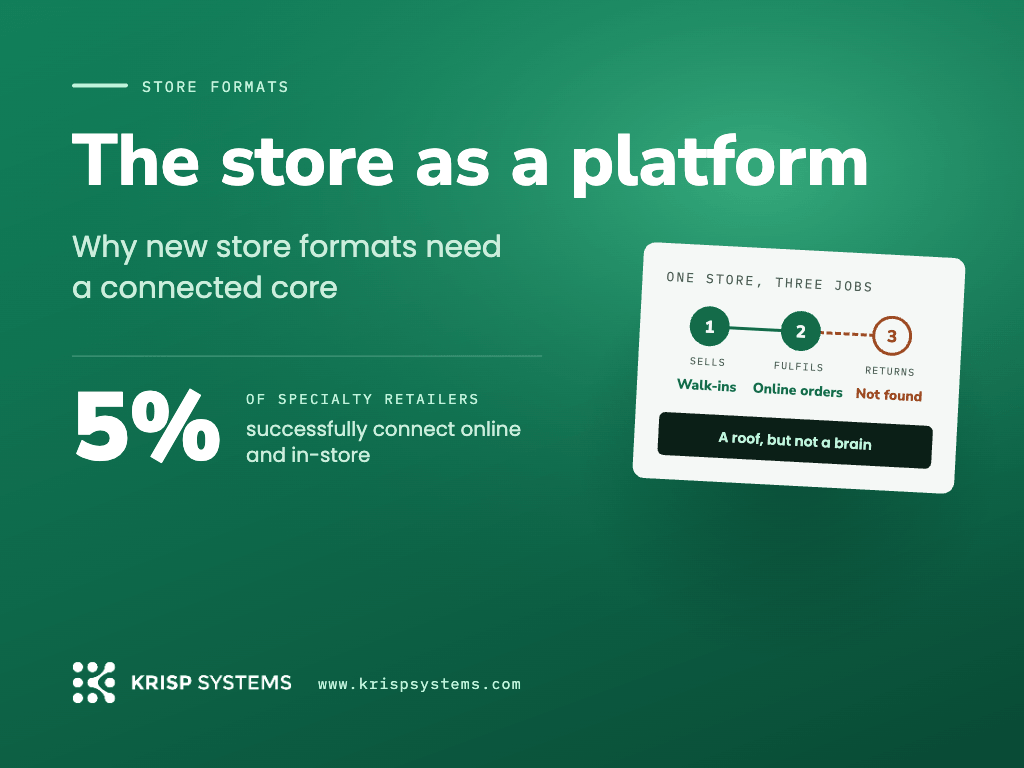
A smartphone is not valuable because of any single app. It is valuable because one operating system lets every app run on the same device, share the same data, and work together. A store now works the same way. Selling, fulfilment, returns, and endless aisle are the apps. The connected core of POS, orders, and inventory is the operating system. Without it, you do not have a platform. You have a set of functions sharing a roof but not a brain.
Each job the store takes on is really a request made of that same core.
| The store’s role | What it does | What it needs from the connected core |
|---|---|---|
| Selling | Serves walk-in customers | Accurate local stock and current price |
| Fulfilment | Ship-from-store, click and collect, delivery | Real-time network inventory and order routing |
| Returns | Takes back online and in-store purchases | Recognises the original order, reconciles to one stock position |
| Endless aisle / showroom | Sells beyond what is on the shelf | Visibility of stock across the whole network |
| Experience and service | Clienteling, services, in-store media | Connected customer and order data |
When the core is connected, each new role is another app on the platform. When it is not, each new role is another thing to go wrong on the floor.
The store is now a fulfilment node
The clearest version of this shift is fulfilment. Michaels, the North American arts-and-crafts retail chain of more than 1,300 stores, shipped close to 3 million orders from those stores, as reported by Retail TouchPoints, with buy-online-pickup-in-store making up 70% of its omnichannel orders. During normal trading about 20% of its stores act as fulfilment hubs, rising to around 50% at peak.
That is one store estate doing two jobs at once: serving the people who walk in, and acting as a distribution network for the people who do not. It holds together only because the orders, the inventory, and the store systems work from the same picture. Take that away and ship-from-store becomes the failed picks and phantom stock you see when the core is fragmented.
New formats, same operating system
The newer formats sharpen the point. Dark stores, micro-fulfilment spaces, compact-format stores, experiential flagships, and in-store media all reinvent what a store is for. None of them escapes the core. A dark store is only as good as the inventory accuracy behind it. A flagship offering endless aisle needs to see stock across the network. A clienteling moment needs connected customer and order data to feel personal rather than scripted.
The format keeps changing. The operating system it runs on is always the same.
Few retailers actually have the operating system
This is where most retailers are exposed. In a 2025 unified commerce benchmark run by Manhattan Associates, only 5% of specialty retailers were judged to successfully connect their online and in-store experiences, while the leaders who did grew around three times faster than the rest.
So the ambition to make the store a platform is nearly universal, and the connected core to support it is rare. That gap is the whole problem. A store can be asked to sell, fulfil, return, and showcase at once, but if each role runs off a different system, the staff and the customer feel every seam.
Krisp Systems helps retailers connect POS, orders, inventory, and fulfilment into one operational view, so a store can take on new roles without taking on new friction. The selling, the fulfilment, the returns, and the endless aisle all draw on one accurate picture of stock and orders. The store becomes a genuine platform, not a pile of disconnected functions.
The practical takeaway
For most retailers, the store estate is the single biggest asset they own, and they are investing in it again. That investment only pays off if the store can carry the new jobs being loaded onto it.
Before adding the next capability to your stores, whether fulfilment, endless aisle, or a new format, it is worth asking whether they all run on the same connected core. If they do, the store compounds in value with every role it takes on. If they do not, every new role is another app crashing on a phone with no operating system.
FAQs
What does “the store as a platform” mean?
It means the physical store is no longer only a place to sell. It also fulfils online orders, processes returns, acts as a showroom and service point, and hosts new formats, all running on the same underlying systems.
Are physical stores still important?
Yes. The US Census Bureau puts e-commerce at about 17% of US retail sales, and the ABS puts online at around 12 to 13% in Australia, so the large majority of sales still happen in stores.
Why do new store formats need a connected core?
Because every role a store takes on, from ship-from-store to endless aisle, depends on accurate, shared data across POS, orders, and inventory. Without it, each new format adds friction instead of value.
What is an example of a store acting as a platform?
Michaels, the North American arts-and-crafts chain, uses its stores as fulfilment hubs, shipping millions of online orders from the shop floor while also serving walk-in customers, which only works when orders and inventory are connected.
How can retailers prepare stores for new roles?
By connecting POS, orders, inventory, and fulfilment into one operational view, so the store can add selling, fulfilment, returns, and experience roles without each one running on a separate system.
Want your stores to take on new roles without new friction? Talk to Krisp Systems about connecting POS, inventory, orders, and fulfilment into one operational view.