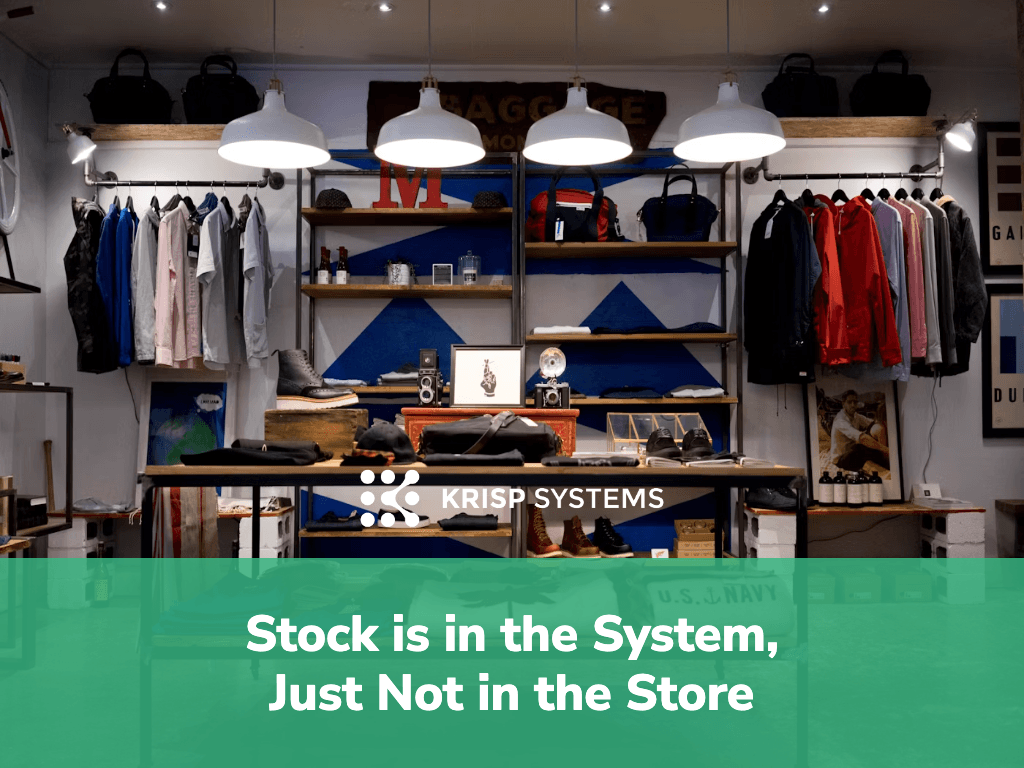
A customer wants a specific product, size, or colour. The store does not have it on the floor. The associate checks the system, and the item exists, just not here. It might be in a store across town, in another region, or in a warehouse. The customer is standing in front of someone who can see the stock but cannot get it to them, so they leave and often buy it somewhere else.
The product was never really missing. It was just in the wrong place. This is one of the most common and least discussed problems in retail, and it is an allocation problem, not a shortage.
The problem is location, not quantity
Retailers tend to think about stock as a total. The more useful question is where that total sits. A business can hold plenty of a product across its network and still miss the sale because none of it is in the store the customer walked into.
IHL Group put a number on part of this. When a shopper gets help and the system says an item is in stock but the team still cannot find it in the store, it costs retailers an estimated US$156.9 billion in sales a year. That is stock that exists on paper, in a location the customer cannot reach in that moment. It sits alongside the larger issue of empty shelves, which IHL found accounts for about 59% of walkouts, but the “in the system, not in front of me” gap is its own distinct and expensive problem.
Replenishment is meant to fix this, but replenishment will never be an exact science. Demand shifts by store, by week, and by season faster than any allocation model can perfectly follow. There will always be a gap between where stock is and where the customer is. The question is whether the store can do anything about that gap in the moment, or whether it just watches the sale leave.
The store shelf can only hold so much
Part of the gap is physical. A store has finite space, so it can only carry a fraction of the range a website can list.
AlixPartners found that in-store assortments are on average only about 9% as large as online assortments, ranging from 2% in mass retail to 32% in specialty. It gave a concrete example, that Macys.com lists around 24,000 women’s tops while about 2,500 are on the shop floor. Yet AlixPartners also found 82% of shoppers expect to see the same product across channels. The customer does not think in terms of store range and online range. They think the brand either has the product or it does not.
So the store is judged against the full online catalogue while physically able to hold less than a tenth of it. That is not a buying failure. It is the nature of a physical shelf, and it is exactly the gap a website closes by sourcing from anywhere.
Customers already want you to source it
The encouraging part is that shoppers are not only willing to let a retailer fulfil from elsewhere, many already expect it.
AlixPartners found that when an item is out of stock in a store, 36% of shoppers order it online from the same retailer, 34% order it online from a different retailer, and 31% try to find it in-store from a different retailer. More than a third are ready to give the original retailer the sale if it can source the item from elsewhere. The intent is there at the counter. What is usually missing is a way for the store to act on it before the customer walks out and that intent drifts to a competitor.
What it costs to let them walk
When the store cannot close the gap, the sale rarely waits.
Zebra’s 17th Annual Global Shopper Study found that out-of-stocks are the number one reason customers leave a store without buying, with 57% leaving without items they wanted. AlixPartners found that two-thirds of shoppers, 66%, will leave a store or website and shop elsewhere when an item is out of stock.
These are not small leaks. They are the routine, daily cost of a store that can only sell what is physically on its own shelves.
Giving the store the website’s reach
This is where endless aisle earns its place. A website can sell a product held anywhere in the network and arrange for it to ship to the customer. Endless aisle gives the store the same ability. When the local shelf is short, the associate can still sell the item and have it fulfilled from another store, a warehouse, or a supplier, and delivered to the customer’s home or the store for pickup.
The store stops being limited to its own four walls and starts selling from the whole network. The sale that would have walked out the door is captured, and the customer gets what they came for.
None of this works without a connected view of stock. Krisp Systems helps retailers connect POS, orders, inventory, and fulfilment into one operational view, so store teams and head office can see what is available across the network, what is committed, and what can be fulfilled from where. That connection is what lets a store confirm stock in another location, sell it with confidence, and hand off fulfilment without a round of phone calls. Endless aisle is only as reliable as the inventory view behind it.
Managing a gap that will never fully close
The point is not to make allocation perfect. It never will be. Demand is too variable and store space is too limited for replenishment to put every product in exactly the right place at the right time.
The point is to give the store a way to manage the gap when it appears. A store that can source across the network turns an unavoidable allocation gap into a fulfilled order rather than a lost sale. Over a year and across locations, that difference is the sales a business recovers simply by letting its stores sell like its website already does.
There is a payoff on the other side of getting this right. Manhattan Associates found that only 7% of retailers have reached true unified commerce leadership, and that those leaders grow at nearly twice the rate of the rest, at a time when more than 66% of consumers use two or more channels before they buy. Connecting inventory so stores can sell from the whole network is a large part of what separates that 7% from everyone else.
The practical takeaway
If your stores can only sell what is on their own shelves, you are losing sales that your business could easily fulfil from somewhere else.
The stock is often already there, just not in the store the customer is standing in. Endless aisle, built on a connected view of inventory, lets the store reach the rest of the network and save the sale. It does not require perfect allocation. It just requires the store to stop being an island.
FAQs
What is endless aisle in retail?
Endless aisle lets a store sell and fulfil products it does not physically hold by sourcing them from elsewhere in the retailer’s network, such as another store, a warehouse, or a supplier. It gives the store the same reach a website has.
Why do stores lose sales when the product exists elsewhere?
Because a store can usually only sell what is on its own shelves. If the item is in another location, the associate can see it in the system but cannot act on it, so the customer leaves and often buys from a competitor.
Is this a stock shortage or an allocation problem?
Often an allocation problem. The business holds enough stock across its network, but it is not in the store the customer is in. Endless aisle addresses the allocation gap rather than requiring more total stock.
Do customers actually want to order from another location?
Many do. AlixPartners found that when an item is out of stock in-store, 36% of shoppers will order it online from the same retailer. The willingness to let the retailer source from elsewhere is already there.
What does endless aisle need to work?
A connected, trusted view of inventory across the network. The store has to be able to confirm stock in another location and hand off fulfilment reliably, which depends on POS, orders, inventory, and fulfilment being joined up.
Want your stores to sell from anywhere in your network, not just the shelf in front of them? Talk to Krisp Systems about connecting POS, inventory, orders, and fulfilment into one operational view.