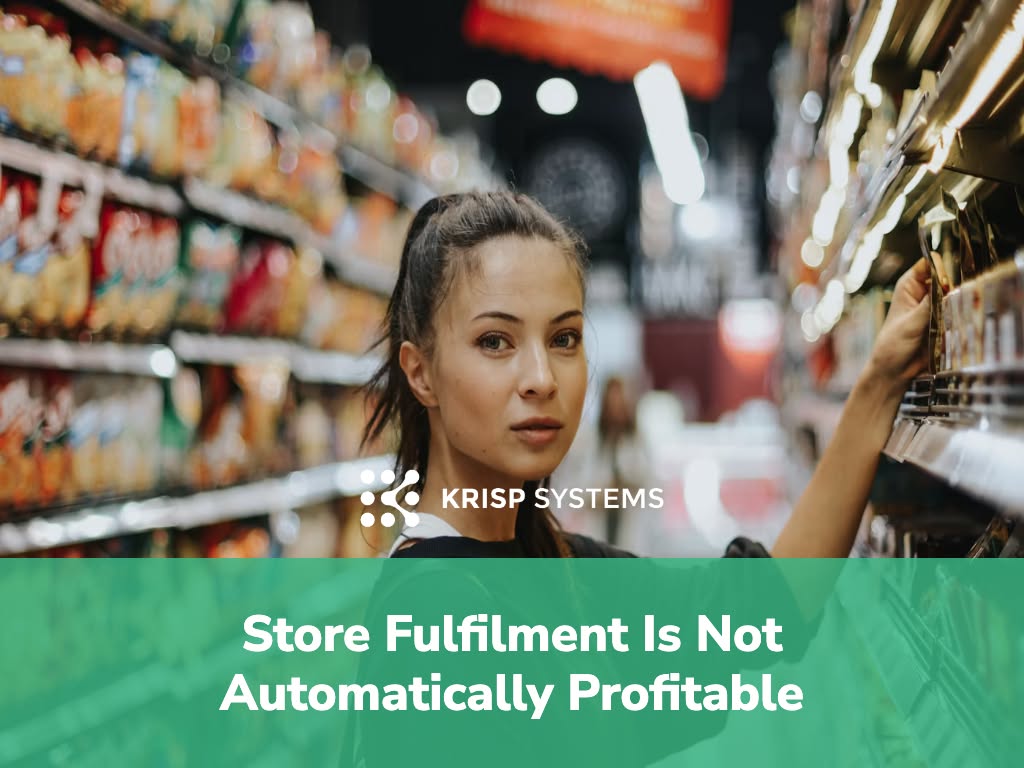
Using stores to fulfil online orders looks like an easy win. The stock is already there, the location is close to the customer, and the order skips the trip through a distribution centre. On paper, it should be cheaper and faster.
The paper maths does not always hold. McKinsey has estimated that simpler in-store fulfilment models run within about 20% of traditional distribution-centre costs, reaching parity only when automation is added. Put plainly, fulfilling from a store is often not cheaper than a distribution centre, and can cost more. The option itself does not protect margin. The way it is executed does.
Store fulfilment is now mainstream
Fulfilling from stores is no longer a trial. In Salesforce’s Connected Shoppers Report, 6th Edition (2025), ship-from-store is already offered by 53% of retailers, with a further 40% planning to add it. Demand is there too, with 56% of shoppers saying they have bought online to be delivered from a store.
That scale is the point. When store fulfilment was a small share of orders, doing it imperfectly cost little. As it becomes a mainstream channel, the economics of each order start to show up in the bottom line.
Why cheaper is not automatic
The assumption that store fulfilment is cheaper rests on everything going smoothly. Often it does not.
Picture a single online order for three items routed to a store. An associate leaves the floor to pick it, which is labour that was meant for serving customers. One of the three lines is not actually on the shelf, so the order splits into two shipments and the second item ships from another location at a second shipping cost. A day later a customer arrives to collect a different order that is not ready, so a second staff member goes looking for it while the customer waits.
None of these show up as a single large cost. They show up as small leaks, spread across thousands of orders. The item that looked cheaper to send from a store ends up costing more once the picking time, the split shipment, and the follow-up are counted. That is exactly how a channel meant to save money slides towards McKinsey’s upper end, or past it.
The upside is real when the order is ready
Store fulfilment can also lift margin, and it is worth being clear about how.
Click and collect is the strongest example. When a customer comes in to collect, they often buy more while they are there. ICSC found in December 2025 that 64% of click-and-collect shoppers made additional purchases when picking up in store. That incremental basket is real margin, and it is unique to store fulfilment.
But it only happens if the order is ready and the pickup is smooth. A customer who waits at a counter while someone hunts for their order does not wander the aisles adding items. The upside and the leak come from the same moment, and execution decides which one you get.
Where the margin leak
The most common leak sits in stock accuracy at the store.
When an order is accepted against a figure that turns out to be wrong, the cost lands straight away. The order is cancelled or split, the customer is disappointed, and the team spends time unwinding it. A cancelled ship-from-store order is worse than one that was never promised, because the retailer has already paid in labour and lost the customer’s confidence at the same time.
Returns sit in the same picture. The National Retail Federation and Happy Returns estimated returns at US$890 billion in 2024, about 16.9% of retail sales. Every store handling online fulfilment is usually handling cross-channel returns as well, and each return has to find its way back to an accurate stock position before that unit can be sold again. If the store cannot see and trust its own numbers, returns quietly become another source of phantom stock and another cancelled order down the line.
For multi-location retailers, this multiplies. Every store that accepts online orders against an unreliable stock position is a place where a promise can break.
Making store fulfilment pay
Profitable store fulfilment depends on one connected view of stock, orders, and store activity.
Krisp Systems helps retailers connect POS, orders, inventory, and fulfilment into one operational view, so store teams and head office can see what is available, what is pending, and what needs action. That connection is what lets orders route to a store that can genuinely complete them, against stock the team can trust, with fulfilment work visible alongside everything else the store is handling.
The aim is not to fulfil from stores as often as possible. It is to fulfil from them when it makes sense, and to protect the margin when it does. A connected view is what turns that into a judgement rather than a gamble.
The practical takeaway
Store fulfilment is a real opportunity, but it is not free money. The savings only appear when orders route well, stock figures hold, and store teams can absorb the work without dropping service.
Before expanding ship-from-store or click and collect, it is worth asking whether the systems behind them can confirm stock and coordinate fulfilment reliably. If they cannot, growing store fulfilment can grow the leaks just as fast. The option is only as profitable as the execution beneath it.
FAQs
What is store fulfilment?
It is using retail stores, rather than only distribution centres, to fulfil customer orders. It covers ship-from-store, click and collect, and delivery from a nearby store.
Is store fulfilment cheaper than shipping from a distribution centre?
Not automatically. McKinsey has estimated simpler in-store fulfilment runs within about 20% of distribution-centre costs, reaching parity only with automation. The saving depends on execution, since picking labour, split shipments, and cancelled orders can erode or erase it.
Why do ship-from-store orders lose money?
Usually because an order is accepted against an inaccurate stock figure, then cancelled or split, or because picking pulls staff away from serving customers. These costs are small individually but add up across many orders.
Does click and collect help margin?
It can. ICSC found 64% of click-and-collect shoppers made additional purchases at pickup in December 2025. That incremental basket only appears when the order is ready and the pickup is smooth.
How can retailers make store fulfilment more profitable?
By routing orders to stores that can complete them fully, giving teams clear pick priorities, watching store capacity, and connecting POS, orders, inventory, and fulfilment so decisions rest on one trusted view.
Want to see whether your store fulfilment is protecting margin or quietly eroding it? Talk to Krisp Systems about connecting POS, inventory, orders, and fulfilment into one operational view.