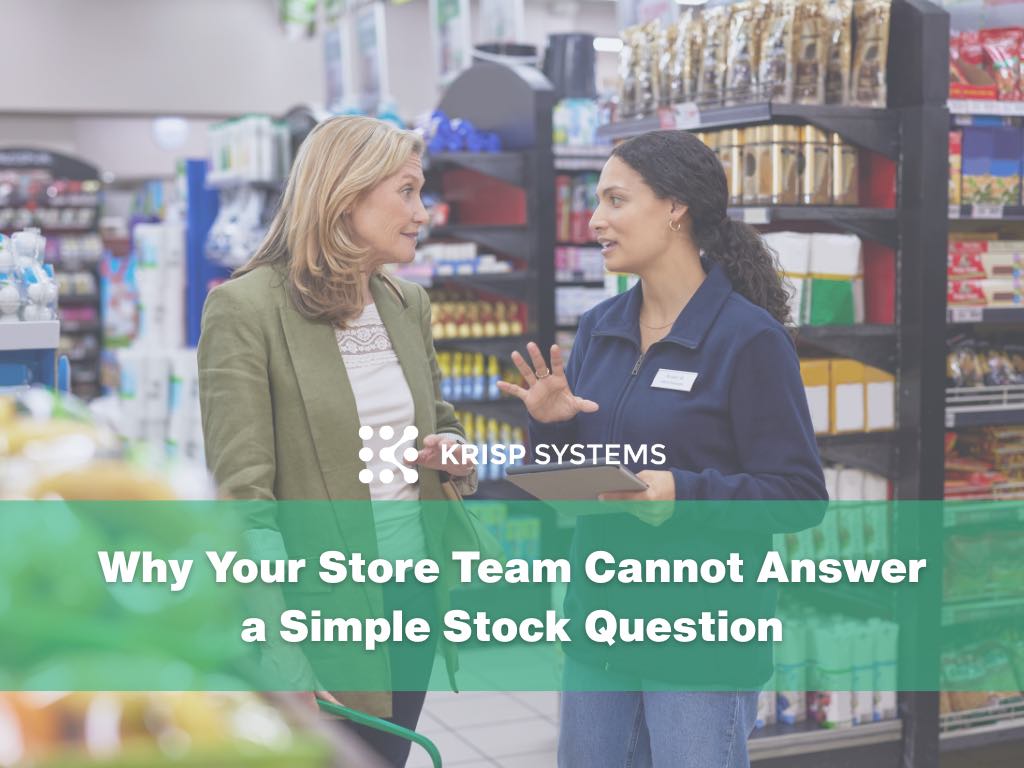
A customer holds up a product and asks the question every retailer hears every day. Do you have this in another size, or at another store, or can it be sent to my home. It sounds simple. For many store teams, it is not.
The associate is not slow and is not unwilling. They are working across more systems than the question should ever require. To answer with confidence, they may need to check stock on one screen, order status on another, and a separate tool for what is available at nearby stores. By the time they have pieced it together, the moment has cooled and the customer is already deciding whether to wait or walk.
This is not a staffing problem. It is a visibility problem, and it sits right at the front of the store.
A simple question that is no longer simple
The number of tools sitting between an associate and a confident answer has grown. Salesforce’s Connected Shoppers Report, 6th Edition (2025), found that new store associates now have to master an average of 16 different systems each day, up from 12 in 2023.
Each system holds part of the picture. None holds all of it. So a question that should take seconds becomes a small investigation, repeated dozens of times a shift across a team that is already busy.
The cost is easy to miss because it never appears as a single event. It shows up as a pause, a phone call to another store, or a trip out the back to check. On its own, each one looks minor. Across a day and across locations, they add up to a quiet drain on the floor.
The pressure the team already feels
Store teams feel this gap, and so do the people running the business. In the same Salesforce research, 81 per cent of retailers said inefficient processes and technology drain store associate productivity. Only 17 per cent of associates have access to a unified view of the information they need as they move between disconnected systems.
So the people serving customers and the people running the business agree on the problem. The stock figure is hard to trust and hard to reach in the moment it is needed.
When that happens, teams adapt in ways that cost the business. They give cautious answers to avoid promising something they cannot confirm. They check and recheck. Some stop relying on the system in front of them and build their own workarounds. None of this is carelessness. It is what people do when the tools do not give them a clear answer.
What the customer experiences
The customer does not see your systems. They see how quickly and clearly your team responds.
When an associate can confirm availability on the spot, the interaction feels easy and the customer stays engaged. When the answer is “let me go and check” followed by a wait, the experience changes. The customer starts weighing up whether it is worth it, and they often have a phone in hand showing them other options while they wait.
Product availability is now one of the first things shoppers consider when they decide where to buy. A team that can answer availability questions with confidence is doing more than being helpful. They are holding the sale together at the point it is most likely to slip.
Why this is a visibility problem, not a staffing problem
It is tempting to read slow answers as a training or staffing issue. More often, the limit is the information the team can reach, not the people themselves.
The point of sale shows what is happening in the store, including sales, returns, and collections. The order management layer handles how orders move and where they are fulfilled. Inventory sits across both. When these run on separate systems, the associate has to do the joining work manually, in real time, while a customer waits. No amount of extra training removes that friction. The structure of the information is the problem.
This is why giving teams better answers usually means giving them one view rather than more tools. The priority is being recognised. In Zebra Technologies’ 18th Annual Global Shopper Study (2025), optimising inventory processes became the leading way retailers believe they can lift profit on online orders, rising to 38 per cent from 29 per cent a year earlier. The recognition is there. What many teams still lack is a connected view they can rely on in the moment.
Giving the floor one clear view
Confident answers come from one operational picture, not from jumping between screens.
Krisp Systems helps retailers connect POS, orders, inventory, and fulfilment into one operational view, so store teams and head office can see what is available, what is pending, and what needs action. The value is not in adding another system to the 16 the team already manages. It is in reducing what they have to check, so the answer to a stock question lives in one place they trust.
When the view is shared, the everyday interaction changes. An associate can confirm stock at another location without a phone call. They can see whether an order is ready before the customer reaches the counter. They can offer to send an item from a store that has it, knowing the figure behind that promise is real. The team spends less time confirming and more time serving.
The practical takeaway
If your store teams are slow to answer stock questions, the first place to look is not the team. It is the number of systems standing between them and a clear answer.
Inventory visibility is often treated as a back-office concern, but it is felt most sharply on the floor, in the seconds a customer is waiting. Giving teams one connected view of stock, orders, and fulfilment is what turns a hesitant “let me check” into a confident answer, and that is where the customer experience is won or lost.
FAQs
Why do store associates struggle to check stock quickly?
Often because the information is spread across several systems. Associates may need separate tools for store stock, order status, and availability at other locations, so a single question requires joining several sources manually while the customer waits.
Is slow stock-checking a training problem or a systems problem?
Usually a systems problem. Training helps, but if the stock figure is hard to reach or hard to trust, even experienced associates will be slow and cautious. A connected view of stock and orders addresses the root cause.
What is real-time inventory visibility?
It is the ability to see accurate stock across the business as it stands now, including what is available, what is allocated, and what is in transit, across stores and channels. It lets teams answer availability questions without guessing.
How does connecting POS and OMS help store teams?
The point of sale records store activity and the order management system handles order movement and fulfilment. Connecting them, with inventory across both, gives associates one consistent view instead of several disconnected screens, so they can answer and act faster.
Why does this matter more for multi-location retailers?
With more stores and channels, the same stock question can return different answers depending on which system is checked. Without a connected view, associates spend more time coordinating between locations and customers wait longer for a confident answer.
Want to give store teams a clearer view of stock, orders, and fulfilment? Talk to Krisp Systems about connecting POS, inventory, orders, and fulfilment into one retail operating foundation.
Sources
Salesforce, Connected Shoppers Report, 6th Edition (2025). salesforce.com
Zebra Technologies, 18th Annual Global Shopper Study (November 2025). zebra.com