Retail shrinkage is often treated as a theft issue. A product leaves the store unpaid, the loss is recorded, and the response usually sits with loss prevention, security, or store management.
That version of shrinkage is real, but it is not the whole problem.
Revenue also leaks through quieter moments. A refund is processed incorrectly. A self-checkout transaction misses an item. A product is scanned under the wrong SKU. A return comes back into the store but does not update inventory properly. A fulfilment exception gets adjusted without anyone seeing the pattern behind it.
None of these moments may look large on their own. Across stores, registers, products, orders, returns, and stock movements, they become a margin problem.
The National Retail Federation reported that shrink represented $112.1 billion in retail losses, with the average shrink rate reaching 1.6% of sales. That figure matters, but the bigger issue is not only the size of the loss. It is whether retailers can see where that loss is starting.
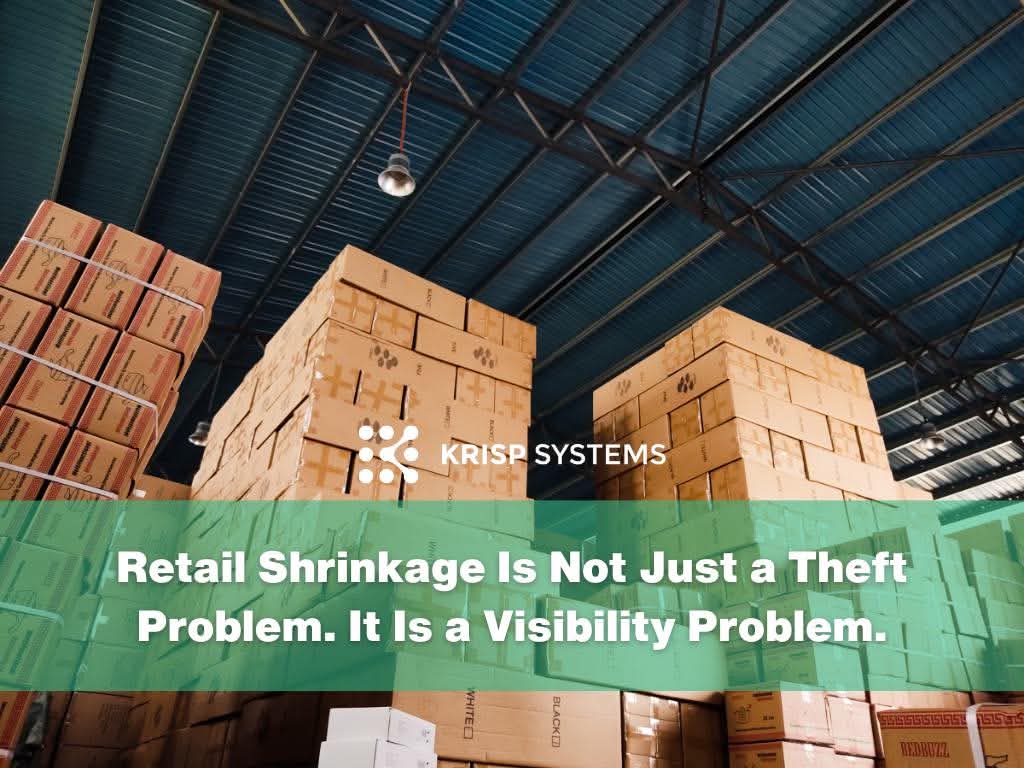
Shrinkage is no longer only a loss prevention issue.
It is an operational visibility issue.
Revenue Leakage Often Looks Like Normal Store Activity
One reason shrinkage is difficult to manage is that it does not always look suspicious in the moment. A refund, void, discount, transfer, stock adjustment, damaged item, or self-checkout exception can all be part of normal store activity.
The risk begins when these actions are not connected to the wider operational picture.
A refund should connect back to the original transaction. A stock adjustment should connect to inventory movement. A fulfilment exception should connect to the order. A return should update the product’s condition and availability. A transfer should show whether stock actually moved from one location to another.
When those links are missing, retailers are left with fragments. The POS shows the transaction. Inventory shows the adjustment. The OMS shows the fulfilment status. Finance sees the margin impact later.
But no single view explains what really happened.
That is how revenue leakage becomes hard to trace. Not because no one is looking, but because the full story is spread across too many systems.
Self-Checkout Shows the Risk of Convenience Without Control
Self-checkout is a clear example of how convenience can create new shrinkage risk when visibility does not keep up.
The benefit is clear. Self-checkout can reduce queues, speed up simple transactions, and give customers more control over the checkout experience. But it also changes where control sits.
In a staffed checkout, the cashier acts as both a service point and a transaction control point. In self-checkout, that control shifts into the system, exception alerts, staff supervision, and post-transaction analysis.
That shift matters.
Studies have reported self-checkout shrink rates around 3.5%, compared with roughly 0.2% to 0.21% for staffed checkout.
That does not mean self-checkout has no place in retail. It means retailers need clearer visibility into what is happening around those transactions.
Which lanes have repeated exceptions? Which items are missed most often? Which stores show unusual void or refund behaviour? Which product categories are most exposed?
Those are not only security questions.
They are operational questions.
Theft Is Rising, but Recovery Is Limited
Theft remains a serious part of the shrinkage picture. Reporting on NRF’s retail theft research cited a 26% increase in shoplifting incidents from 2022 to 2023, which shows that pressure on retailers is not easing.
The recovery rate makes this more concerning.
Jack L. Hayes International reported that for every $1 recovered, $8.18 was lost to retail theft. That means only 10.9% of total retail theft losses resulted in recovery.
This should change how retailers think about shrinkage.
If most theft losses are not recovered, the priority cannot only be catching losses after they happen. Retailers need earlier signals. They need to know when patterns are forming, when transactions and stock movement stop matching, and when store activity starts pointing to preventable leakage.
The goal is not to stop every loss.
The goal is to reduce the losses that stay hidden inside delayed reporting, disconnected systems, and broad stock adjustments.
A Single Shrinkage Number Is Not Enough
Shrinkage is often reported as one number. That number may tell leadership the size of the problem, but it does not always explain the cause.
A 1.6% shrink rate does not show whether the issue came from theft, missed scans, refund misuse, supplier discrepancies, damaged stock, fulfilment exceptions, store transfers, or receiving errors.
That distinction matters because each cause needs a different response.
Theft may require store controls and safety measures. Refund misuse may require stronger transaction matching. Self-checkout issues may require better exception monitoring. Stock movement problems may require clearer receiving, transfer, and fulfilment workflows.
When very different issues are collapsed into one number, retailers may respond too broadly.
They may add more friction without solving the real cause.
Retailers need the number, but they also need the story behind the number.
POS, Inventory, and OMS Data Need to Work Together
The POS is one of the strongest shrinkage signals because it captures where value is recorded or lost. It shows sales, refunds, voids, discounts, exchanges, overrides, returns, and user-level activity.
But POS data alone does not tell the full story.
Inventory data shows what moved, what was adjusted, what was counted, and what should still be available. OMS data shows whether stock was picked, packed, cancelled, transferred, returned, reassigned, or delayed.
Modern shrinkage can happen at checkout, but it can also happen during fulfilment, transfer, receiving, returns, or order handling.
That is why disconnected data creates risk.
A product can appear sold in one system, available in another, and missing during the next count. A refund can look normal until it is connected to repeated product discrepancies. A stock adjustment can look routine until it appears across multiple stores or fulfilment workflows.
The value is in context.
Retailers need to connect transaction data, inventory movement, and order activity so they can see where leakage may be starting.
Better Visibility Should Reduce Friction, Not Add More
Retailers often respond to shrinkage by adding more control. They may lock products away, tighten return policies, increase audits, add staff checks, or make checkout more restrictive.
Those actions can help in the right situations, but they can also create friction for legitimate customers and more pressure for store teams.
The better question is not always, “How do we add more control?”
The better question is, “Where do we need more visibility before we add more friction?”
If self-checkout exceptions are rising, the retailer should be able to see whether the issue is product mix, staffing, process design, or behaviour. If a category has repeated stock discrepancies, the retailer should be able to trace whether the issue is theft, missed scans, receiving errors, damaged goods, or fulfilment adjustments.
Better visibility helps retailers respond more precisely.
It allows them to protect revenue without making the entire shopping experience slower, more restricted, or harder to trust.
Shrinkage Is a Signal of Operational Health
Shrinkage affects more than the loss line. It weakens margin, reduces inventory confidence, creates artificial stockouts, increases store workload, and makes fulfilment promises harder to trust.
That is why retailers need to look at shrinkage as part of execution.
When shrinkage rises, the question should not only be, “Who took the product?”
It should also be, “Where did the business lose visibility?”
Krisp Systems helps retailers connect POS and OMS into one clearer retail foundation, bringing transactions, orders, inventory, fulfilment, and store-level activity closer together.
That connected view can make leakage easier to investigate. A suspicious refund becomes clearer when it can be tied back to the original transaction, inventory movement, store location, order, and fulfilment status. A stock discrepancy becomes easier to understand when teams can see whether the item was sold, returned, transferred, adjusted, picked, cancelled, or marked unavailable.
The value is not in turning POS or OMS into a security tool.
The value is in giving retailers clearer operational visibility so they can detect leakage earlier, reduce preventable errors, and protect margin with more confidence.
Final Thought
Retail shrinkage is not always a dramatic event. Sometimes it looks like a missed scan, a return mismatch, a stock adjustment, a void, a fulfilment exception, or a system that cannot explain where the value went.
That is why shrinkage should not be treated only as theft.
It should be treated as a visibility problem across the retail operation.
Retailers that can connect the signals across POS, orders, inventory, returns, and fulfilment will be better placed to protect revenue, preserve margin, and keep inventory data trustworthy.
FAQs
What is retail shrinkage?
Retail shrinkage is the difference between recorded inventory and actual inventory. It can be caused by theft, missed scans, incorrect refunds, administrative errors, damaged stock, vendor discrepancies, fulfilment issues, or process gaps.
What is revenue leakage in retail?
Revenue leakage is value lost across the retail operation because sales, stock, returns, orders, or fulfilment activity are not captured, controlled, or reconciled properly.
Why is shrinkage more than a theft problem?
Shrinkage includes theft, but it can also come from checkout errors, return mismatches, stock adjustments, fulfilment issues, pricing errors, and disconnected systems. Treating it only as theft can hide operational causes of loss.
How does POS data help reduce shrinkage?
POS data helps retailers understand what happened at the transaction level, including sales, refunds, voids, discounts, exchanges, self-checkout exceptions, and user-level behaviour.
Why does OMS data matter for shrinkage?
OMS data shows what happens during fulfilment. It helps retailers see whether stock was picked, packed, cancelled, transferred, returned, reassigned, or delayed.
How does inventory visibility reduce revenue leakage?
Inventory visibility helps retailers connect stock movement with transactions, returns, transfers, fulfilment activity, and adjustments. This makes it easier to understand whether leakage is caused by theft, error, or process failure.
Want to reduce revenue leakage with clearer visibility across POS, orders, inventory, and fulfilment? Talk to the Krisp Systems team about building a more connected retail foundation [Talk to Our Team]