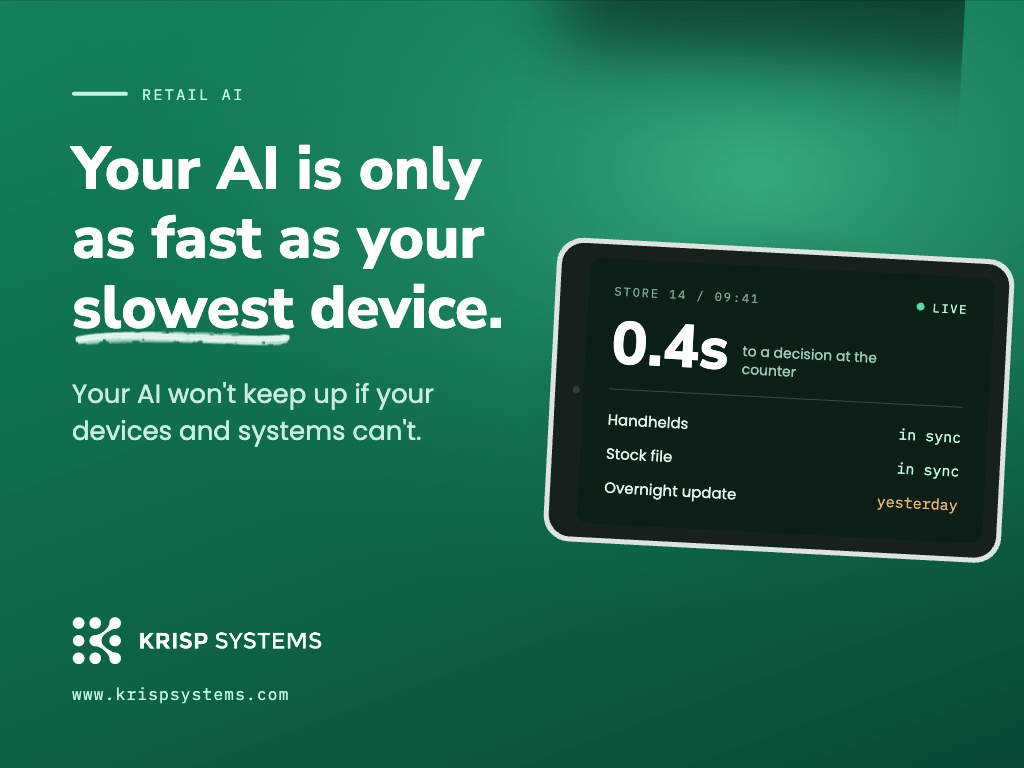
Retail is spending heavily on AI, and much of it is landing on the shop floor: assisted selling, real-time availability, computer vision, smarter self-checkout. The ambition is real. The problem is that AI on the frontline only moves as fast as the device it runs on, the network it relies on, and the data it reads. When any of those cannot keep up, the AI does not look clever. It looks broken.
This is the gap most AI plans miss. The model gets the budget and the headlines. The infrastructure it depends on does not, and that is usually where the value quietly leaks away.
The ambition is outrunning the infrastructure
The appetite is not the issue. In a 2026 study by Incisiv for Verizon and Cisco, 83% of retailers said AI is now a necessity to compete, yet only 6% rated their own AI capabilities as mature.
That is a wide gap between wanting AI and being able to run it. When the same study asked what was holding deployments back, the top answers were not about the models. They were about the plumbing: poor or siloed data and system integration challenges. AI does not run on ambition. It runs on infrastructure.
What “can’t keep up” actually looks like
AI on the frontline sits on three layers, and it fails at the level of whichever one is weakest.
| Layer | What it does for AI | What happens when it lags |
|---|---|---|
| Devices | Run the AI app and capture the data it needs | Slow responses, crashes, hardware that cannot run modern models |
| Network and edge | Move and process data in real time, close to the store | Latency, outages, and answers based on stale data |
| Data and systems | Feed accurate stock, price, and order information | Confident wrong answers drawn from fragmented sources |
AI on the frontline fails at the level of its weakest layer.
A retailer can invest in any one of these and still be let down by the other two. The best device in the world gives a wrong answer if the data behind it is fragmented. The cleanest data is useless if the network drops before it reaches the floor.
When the network drops, so does the AI
Connectivity is the layer that is easiest to overlook and expensive to ignore. Coresight Research, in work sponsored by T-Mobile, found that 87% of retailers face interruptions in real-time data collection due to network outages, and estimated that network connectivity issues cost retailers an average of 5.8% of sales.
Edge readiness is thinner still. In the Incisiv study, only 39% of retailers said they were satisfied with their edge computing support, at the very moment that real-time AI workloads like video analytics are moving closer to the store. Real-time AI needs real-time infrastructure. If the data cannot be captured, moved, and processed fast enough, “real-time” becomes a marketing word rather than a fact.
The frontline feels it first
The people who notice the gap soonest are store associates. Zebra’s Global Shopper Study found that nearly 90% of associates believe they can deliver a better customer experience when they have mobile technology to check prices and inventory and prioritise tasks. The demand for good tools is there.
The point is that an AI assistant handed to an associate on an underpowered device, over a patchy network, reading fragmented stock data, does not help them. It slows them down and gives them answers they learn not to trust. Retailers know investment is coming, with Zebra finding 75% planned to increase technology spending. The question is whether that spend lands on the whole stack or just the visible top of it.
The same moment, two stacks
The difference is not abstract. It shows up in the same everyday moments, decided by whether the stack behind them held.
| The moment | When the stack keeps up | When it can’t |
|---|---|---|
| A customer asks if an item is available at another store | The associate checks on a handheld and confirms in seconds, then offers to have it sent | The app stalls on a weak connection, so the associate phones the other store while the customer waits |
| AI suggests an alternative at the shelf | It recommends an item that is genuinely in stock nearby | It recommends something that sold out an hour ago, because the data lagged |
| Self-checkout hits an exception | On-device vision clears it in real time | It freezes and needs a staff override as the queue builds |
| An associate confirms a price or promotion | The current price applies automatically | An old price shows, and the customer disputes it at the till |
The layer everyone forgets: the data behind the device
Here is the part that is easy to miss when the conversation is about hardware. Even a fast device on a strong network is only as good as the data it reads.
This is where most AI stumbles. In the Incisiv study, poor or siloed data was the single most cited barrier to AI, ahead of integration. Gartner, independently, has predicted that organisations will abandon 60% of AI projects through 2026 if they are not supported by AI-ready data. In retail, that data is the stock, price, and order information spread across POS, order management, and inventory systems that often do not agree. Put AI on top of that and it inherits every disagreement, instantly and confidently.
The connected foundation your AI runs on
Getting AI-ready is not one purchase. It is making sure the device, the network, and the data all keep up together. The first two come from hardware and connectivity partners. The third is where most retailers are weakest, and it is where Krisp sits.
Krisp Systems helps retailers connect POS, orders, inventory, and fulfilment into one operational view, so the stock and price data feeding an AI, an app, or an associate reflects what is actually happening across the business. A modern device makes that data faster to reach. Krisp makes it worth reaching. Without a connected source of truth underneath, better hardware just delivers the wrong answer more quickly.
The practical takeaway
Before funding the next AI initiative, it is worth pressure-testing the stack beneath it. Can the devices run it, can the network carry it, and can the data be trusted when it arrives? If any answer is no, the AI will underperform no matter how good the model is.
The retailers who get value from AI will not be the ones who bought the most of it. They will be the ones whose devices, networks, and data were ready to keep up.
FAQs
Why does retail AI underperform in stores?
Usually because the infrastructure around it cannot keep up. AI on the frontline depends on capable devices, reliable connectivity, and accurate, connected data, and it fails at whichever of those is weakest.
What is AI-ready data?
Data that is accurate, current, and connected enough for AI to rely on. Gartner has warned that most AI projects not supported by AI-ready data will be abandoned. In retail, it means stock, price, and order data that agree across systems.
Why does network and edge readiness matter for AI?
Because real-time AI needs data captured, moved, and processed quickly, often near the store. Coresight found network issues cost retailers about 5.8% of sales, and most retailers are not satisfied with their edge computing support.
Do better devices fix retail AI?
Only partly. A faster device helps, but if the data behind it is fragmented, it simply delivers wrong answers faster. Devices, network, and data all have to keep up together.
How should retailers prepare for AI?
Assess the whole stack before investing. Make sure devices can run the tools, the network can carry the load, and the underlying POS, order, and inventory data is connected and trustworthy.
Want the data layer of your AI to keep up? Talk to Krisp Systems about connecting POS, inventory, orders, and fulfilment into one operational view.