For years, retailers competed on customer experience.
Better apps. Faster checkout. Personalised offers. More delivery choices. Smoother digital journeys.
Those things still matter.
But in 2026, they are no longer enough on their own.
Most retailers now offer some version of modern convenience. The difference is whether they can execute the promise behind it.
Can the product be found?
Can the order be fulfilled?
Can the store support the digital journey?
Can the delivery promise be trusted?
This is where retail competition is shifting.
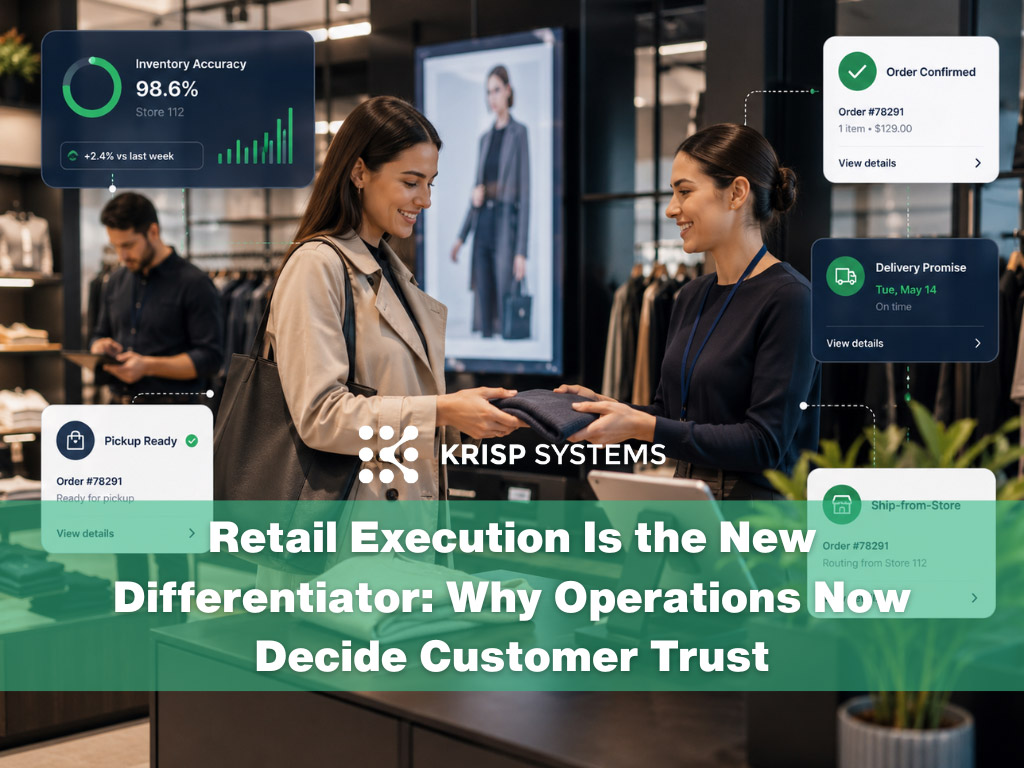
Customer experience may create the promise. Execution determines whether the retailer keeps it.
Research shows that 69% of customers will not return after a failed delivery or fulfilment promise.
That is why retail execution is no longer a back-office concern.
It is now one of the clearest drivers of customer trust, margin protection, and omnichannel performance.
Experience Is the Baseline. Execution Is the Test.
Retailers have invested heavily in customer-facing experiences.
Many now offer ecommerce, mobile apps, BOPIS, endless aisle catalogues, delivery options, returns across channels, and loyalty programmes.
The problem is no longer whether these options exist.
The problem is whether they work reliably when customer demand becomes operational pressure.
A BOPIS order only feels convenient if the item is actually available and ready.
An endless aisle experience only saves the sale if the order can be fulfilled from another location.
Ship-from-store only reduces cost if the store inventory is accurate enough to trust.
A delivery promise only builds loyalty if the retailer can keep it.
This is why retail execution has become the new battleground.
The customer does not see the systems behind the experience. They only see whether the promise works.
The Promise Gap Is Where Retail Execution Breaks
The promise gap appears when the front-end experience says yes, but the operation underneath cannot support it.
It happens when the website shows stock that the store cannot find.
It happens when the POS completes a transaction, but the OMS does not trust the inventory.
It happens when an order is routed to a store that cannot fulfil it.
It happens when an associate wants to save a sale, but the system cannot confirm availability across the network.
These gaps create avoidable friction.
They lead to cancellations, delayed fulfilment, lost sales, additional follow-up, and weaker customer trust.
The issue is not always a lack of ambition.
Retailers often have the right customer-facing ideas.
The issue is that fragmented systems make those ideas harder to execute consistently.
Inventory Accuracy Defines What Retailers Can Promise
Inventory accuracy is one of the clearest signs of execution maturity.
Traditional retail inventory accuracy can still sit around 60% to 65%. Unified-commerce leaders can operate closer to 90% to 98% inventory accuracy.
That gap changes what retailers can confidently promise.
If inventory is not accurate, every retail decision becomes less certain.
Is this product available?
Can this store fulfil the order?
Is the item already allocated?
Can the customer collect today?
Should the order be routed from a store, warehouse, or another fulfilment point?
When retailers do not trust inventory, they often protect themselves with buffers. They hold back stock, avoid promising availability, or route orders through safer but more expensive paths.
That may reduce the risk of cancellation, but it can also create artificial stockouts and missed sales.
Better execution starts with better confidence in what can actually be sold.
Stores Are Now Part of the Fulfilment Network
Stores are no longer only selling locations.
They are becoming fulfilment nodes.
Leading retailers now fulfil 50% to 80% of online orders from stores. This can reduce delivery times and lower last-mile costs by 30% to 50%.
That changes the role of the store.
A store can support ecommerce growth, faster delivery, BOPIS, BORIS, endless aisle, and better inventory utilisation across the network.
But this only works when store inventory can be trusted in real time.
If the system routes an order to a store that does not actually have the item, the cost advantage disappears. The order may be cancelled, delayed, reassigned, or pushed into extra follow-up.
Store fulfilment can be powerful.
Disconnected store fulfilment can become expensive.
Three Retail Moments Where Execution Wins or Loses the Sale
Execution becomes easiest to understand through the moments where customers feel the impact.
1. Endless aisle: can the store save the sale?
A customer wants a size, colour, model, or variant that is not on the shelf.
The associate checks availability.
If the system cannot confirm stock across the network, the associate may hesitate, send the customer online, or lose the sale entirely.
That moment matters because up to 89% of shoppers may leave without purchasing when an item is unavailable and no immediate alternative is offered.
Endless aisle can recover up to 59% of lost sales in out-of-stock scenarios, but only when POS, OMS, and inventory work together.
The POS needs to keep the sale inside the store experience.
The OMS needs to confirm the best fulfilment path.
Inventory needs to show what is available, where it is located, and whether it can be promised.
Without that connection, endless aisle is only a wider product list.
With it, endless aisle becomes a saved-sale workflow.
2. Ship-from-store: can the retailer fulfil from the right place?
In a traditional model, online orders often default to a central distribution centre.
That can mean longer delivery times, higher shipping costs, and stranded stock sitting in stores.
In an execution-led model, the OMS evaluates proximity, inventory confidence, service level, and fulfilment cost.
The order can then be routed to the best store, warehouse, or fulfilment location.
This is where ship-from-store can reduce last-mile costs by 30% to 50% compared with fulfilment models that rely heavily on central distribution.
The opportunity is not simply faster delivery.
It is better use of inventory already positioned closer to the customer.
3. POS-triggered orchestration: can the system prevent cancellations?
Order cancellations are one of the most visible signs of weak retail execution.
They create lost revenue, customer disappointment, and extra work for store, ecommerce, and support teams.
In fragmented environments, the POS may sell inventory the OMS does not trust. The OMS may commit inventory the store does not actually have. The customer only finds out after checkout.
In a unified model, the POS captures store-level truth and the OMS commits only inventory that can be sold and fulfilled.
That shifts execution from reactive to preventative.
The goal is not to fix broken promises after they happen.
The goal is to stop weak promises from being made in the first place.
Why Siloed POS and OMS Struggle to Compete on Execution
Many retailers try to solve execution problems by integrating separate systems.
This can help in limited areas, but it often creates predictable failure points.
Batch-synced systems cannot always support real-time availability.
Different inventory views create distrust between stores, ecommerce, and fulfilment teams.
Each handoff between POS, OMS, inventory, and fulfilment adds latency and risk.
Stores may lose ownership of sales that start online or move across channels, which can reduce adoption and accountability.
Execution needs one version of the truth.
It cannot depend on constant reconciliation between disconnected systems.
What Unified POS and OMS Make Possible
Retail execution improves when the transaction layer and fulfilment layer work together.
The POS captures store-level truth.
It records what is sold, returned, exchanged, picked up, requested, and promised in the store environment.
The OMS manages order movement.
It determines how orders should be routed, reserved, split, fulfilled, or adjusted based on availability, proximity, fulfilment cost, service level, and customer expectation.
When POS and OMS are unified, retailers can support:
- Promise-safe selling
- Intelligent fulfilment routing
- Lower cost-to-serve
- Faster decision cycles
- Stronger inventory confidence
- Cleaner operational data for AI
The value is not only fewer systems.
The value is clearer execution.
Krisp Systems supports this foundation by bringing POS and OMS together in one connected retail platform. This helps retailers manage sales, orders, inventory, fulfilment, and store-level activity from a clearer operational view.
Store teams can respond with better visibility.
Fulfilment teams can work from cleaner order logic.
Retail leaders can see more of what is happening across channels, locations, and stock movement.
The goal is not to add another disconnected tool.
The goal is to help the business execute customer promises with greater confidence.
Execution-Ready Systems Are Also AI-Ready Systems
Retailers are increasingly looking at AI to support forecasting, fulfilment routing, customer service, replenishment, pricing, and inventory decisions.
But AI depends on the quality of the systems underneath it.
If POS, OMS, inventory, and fulfilment data are fragmented, AI will struggle to make reliable recommendations.
A chatbot cannot confidently confirm availability if inventory data is incomplete.
A routing model cannot choose the best fulfilment path if store stock cannot be trusted.
A forecasting tool cannot support better decisions if returns, sales, and order activity sit in separate systems.
AI-ready retail starts with execution-ready data.
That means accurate, real-time, connected information across the systems that run daily retail operations.
Retail Execution Data at a Glance
| Area | Key Data Point | Operational Meaning |
|---|---|---|
| Customer retention | 69% of customers will not return after a failed delivery or fulfilment promise | Broken promises directly affect trust and repeat purchase behaviour |
| Inventory accuracy | Traditional retail sits around 60% to 65%, while unified-commerce leaders operate closer to 90% to 98% | Inventory confidence determines what retailers can safely promise |
| Store fulfilment | Leading retailers fulfil 50% to 80% of online orders from stores | Stores are becoming active fulfilment nodes, not only selling locations |
| Last-mile cost | Ship-from-store can reduce last-mile costs by 30% to 50% | Better routing can improve speed and cost-to-serve |
| Endless aisle impact | Up to 89% of shoppers may leave without purchasing when no immediate alternative is offered | Stockouts create a high-risk moment for lost demand |
| Lost-sale recovery | Endless aisle can recover up to 59% of lost sales in out-of-stock scenarios | Connected POS, OMS, and inventory can help save high-intent demand |
| Growth advantage | Unified-commerce leaders achieve around 2x faster revenue growth and significantly higher customer lifetime value | Stronger execution can support stronger commercial outcomes |
Retail Is Now Won at the Execution Layer
Retail is no longer won only by who markets best, personalises most, or adds the most channels.
Those advantages still matter, but they do not protect the customer relationship if fulfilment fails.
The stronger differentiator is execution.
Can the retailer sell confidently?
Can it fulfil accurately?
Can it deliver profitably?
Can it recover failures quickly?
Can it operate from one source of truth across stores, ecommerce, inventory, orders, and fulfilment?
In 2026, execution is strategy.
Retailers do not lose because they lack ambition.
They lose when their systems cannot support the promises their customer experience creates.
FAQs
What is retail execution?
Retail execution is the ability to turn customer demand into an accurate, fulfilled, and profitable outcome. It includes inventory accuracy, order routing, POS activity, store fulfilment, returns, and customer service workflows.
Why is retail execution becoming more important?
Retailers now offer similar customer-facing experiences, such as ecommerce, BOPIS, delivery options, and endless aisle. The difference is whether those experiences can be executed reliably across stores, digital channels, and fulfilment networks.
How does inventory accuracy affect retail execution?
Inventory accuracy determines whether retailers can make reliable availability and fulfilment promises. If inventory data is wrong, retailers risk cancellations, delays, artificial stockouts, and customer dissatisfaction.
Why do POS and OMS need to work together?
POS captures store-level transactions and customer activity, while OMS manages order orchestration and fulfilment decisions. When they work together, retailers can sell, route, fulfil, and update orders with greater confidence.
How does store fulfilment support retail execution?
Store fulfilment allows retailers to use store inventory to fulfil online orders, support BOPIS, enable ship-from-store, and reduce delivery distance. It works best when store inventory is accurate and connected to OMS routing logic.
What is promise-safe selling?
Promise-safe selling means only offering products, pickup options, delivery dates, or fulfilment promises that the retailer can confidently support with accurate inventory and order data.
How does unified POS and OMS support AI-readiness?
AI needs accurate and consistent data to support forecasting, fulfilment routing, inventory decisions, and customer interactions. Unified POS and OMS help create a cleaner operational data foundation for AI-enabled retail.
Want to make execution a stronger part of your retail strategy? Talk to the Krisp Systems team about unifying POS, orders, inventory, and fulfilment into one connected retail foundation [Talk to an expert button]