A customer walks into a store ready to buy.
The product is not on the shelf.
That moment looks simple from the outside. In reality, it is one of the clearest tests of modern retail execution.
The customer has intent. The store has attention. The sale is close.
But if the retailer cannot offer a reliable alternative, the sale starts to disappear.
Research shows that 10% to 30% of in-store sales can be lost when items are not available on the shelf. In comparison goods retail alone, shopper walk-outs caused by unavailable items are estimated to cost around $500 billion each year.
That is why endless aisle matters.
It is not just a way to show more products in-store.
It is a way to recover demand before the customer leaves.
The Stockout Moment Is Where Omnichannel Is Tested
Retail’s omnichannel promise has been clear for years.
Customers should be able to shop anywhere, order anywhere, and receive products wherever they choose.
But that promise becomes fragile when the product they want is not physically available in the store.
When an item is unavailable, shoppers do not always wait for the retailer to solve the problem. The research shows:
- 17% of shoppers purchase immediately from a competitor
- 37% buy online elsewhere later
- 35% go to another physical store
Together, that means up to 89% of the sale is at risk when the retailer has no way to recover the purchase in the moment.
This is the real problem endless aisle solves.
It gives the retailer a second chance while the customer is still engaged.
Endless Aisle Is No Longer Just an Extended Catalogue
Endless aisle is often misunderstood as a digital catalogue inside the store.
That definition is too narrow.
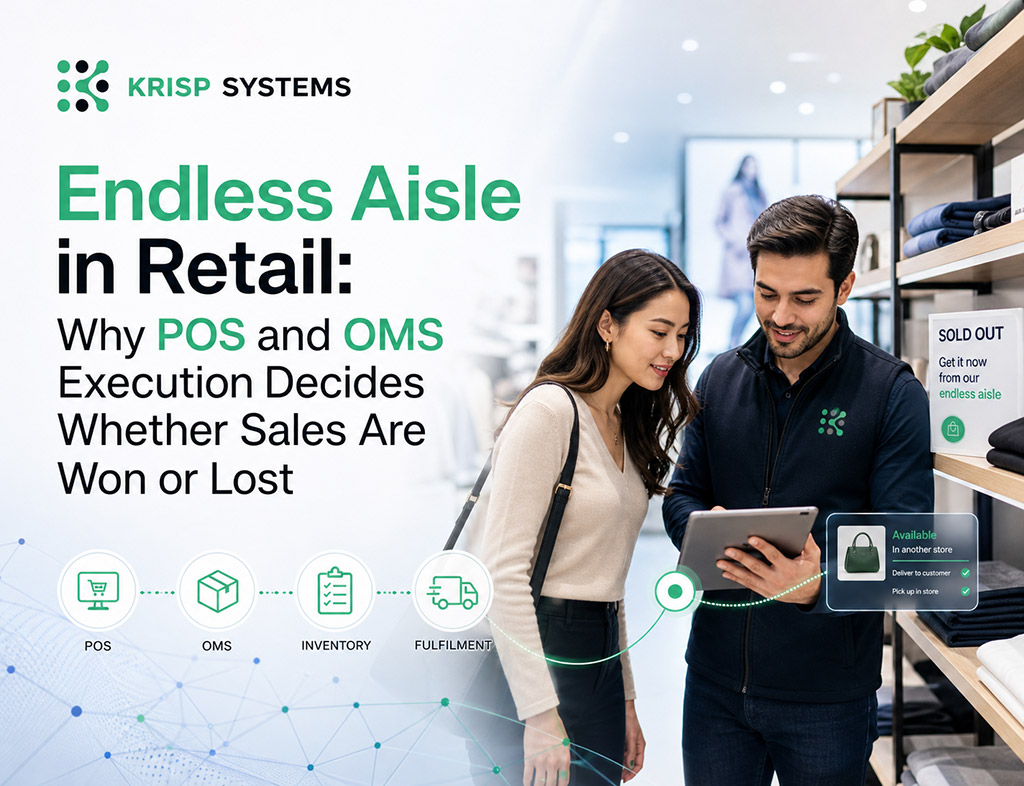
Modern endless aisle allows in-store customers to purchase products that are not physically available at that specific location. The item can be fulfilled from warehouses, distribution centres, other stores, drop-ship partners, suppliers, or extended online assortments. Orders can be placed through the POS, associate tablets, kiosks, or customer devices.
The customer does not need to leave the store.
The associate does not need to send the customer back online.
The retailer does not need to lose the sale just because one shelf, one store, or one location does not have the exact item available.
That is the strategic shift.
Endless aisle is no longer a catalogue feature.
It is a revenue recovery system.
When implemented well, endless aisle can reduce lost sales by up to 58.9% in out-of-stock scenarios. It can also support stronger conversion and higher average order value by helping associates save high-intent shoppers at the point of decision.
Why Endless Aisle Matters More in 2026
Endless aisle is becoming more important because the store environment has changed.
Retailers are under pressure to offer wider choice without carrying every item in every location. Store formats are becoming more selective. Inventory costs remain high. Customers expect online-level assortment even when they are shopping in-store.
This creates a practical challenge.
How can retailers offer broader choice without increasing inventory risk?
Endless aisle helps answer that question.
It allows retailers to carry leaner in-store assortments while still giving customers access to the wider inventory network. This can support better inventory turns, stronger space productivity, and lower markdown risk when fulfilment and inventory data are managed properly.
The market reflects this shift.
The global endless aisle platform market was valued at $1.42 billion in 2024 and is projected to reach $5.18 billion by 2033, growing at around 15.1% CAGR. In fashion, the endless aisle technology segment was valued at $2.47 billion in 2024 and is projected to reach $12.24 billion by 2033, with a projected 18.5% CAGR.
The opportunity is still early.
Penetration remains low compared with the scale of lost sales, which means retailers still have significant room to turn stockout recovery into a competitive advantage.
Endless Aisle Only Works When Inventory Can Be Trusted
Endless aisle creates a better experience only when the promise can be fulfilled.
If an associate orders an unavailable item for a customer, the customer expects that item to arrive as promised. If the order is later cancelled, delayed, or misrouted, the retailer has not saved the sale. It has created a second disappointment.
This is why inventory accuracy is the foundation of endless aisle.
Successful endless aisle implementations typically require at least 95% inventory accuracy at SKU-location level. Below that threshold, availability promises become weaker and cancellations become more likely.
This is where many endless aisle strategies fail.
A longer product list does not solve the problem.
A store kiosk does not solve the problem.
A larger ecommerce catalogue does not solve the problem.
The retailer needs to know where the product is, whether it can be sold, whether it has already been allocated, and how quickly it can be fulfilled.
Without that visibility, endless aisle becomes a risky promise.
With that visibility, it becomes a practical way to recover sales.
POS and OMS Are the Execution Core Behind Endless Aisle
Endless aisle succeeds or fails based on how well POS and OMS work together.
The POS is the in-store anchor.
It allows the associate to keep the customer engaged, complete the order, process payment, and retain ownership of the sale inside the store experience. When endless aisle orders are completed through the POS, the store stays connected to the transaction and channel conflict is reduced.
The OMS is the fulfilment engine.
It determines where inventory should be sourced, whether the order should ship from a store, warehouse, supplier, or distribution centre, and how to balance cost, proximity, availability, and delivery promise. It also supports split orders, exceptions, and network-level fulfilment decisions.
Both systems matter.
If the POS is disconnected, the store may lose ownership of the sale.
If the OMS is weak, fulfilment becomes guesswork.
If inventory is inaccurate, the promise breaks.
If associates are not enabled, adoption stays low even when the technology exists.
Endless aisle is not just a front-end feature.
It is an operational workflow that needs POS, OMS, inventory, fulfilment, and store teams to work from the same source of truth.
Store Fulfilment Makes Endless Aisle More Powerful
Endless aisle becomes even more valuable when it connects with store fulfilment.
If one location does not have the item, another location may be able to fulfil it. If a nearby store has available stock, it may be faster and more cost-effective than sending the order from a central warehouse.
This is why ship-from-store matters.
Research shows that ship-from-store can reduce last-mile costs by 30% to 50% compared with centralised fulfilment. Major retailers now fulfil 50% to 80% of online orders from stores, turning physical locations into active supply-chain nodes.
That changes the role of the store.
The store is no longer only a place where customers browse and buy.
It becomes part of the fulfilment network.
In this model, endless aisle does more than save a single sale. It helps retailers use inventory across the network more effectively.
What Retailers Should Measure
Endless aisle should not be measured only by usage.
It should be measured by whether it improves operational and commercial outcomes.
Retailers commonly track:
- Saved-sale rate after out-of-stock events
- Conversion lift for assisted in-store orders
- Average order value uplift on endless aisle orders
- Order promise accuracy
- On-time delivery performance
- Network-wide inventory utilisation
These metrics matter because they show whether endless aisle is reducing leakage, improving fulfilment confidence, and helping stores capture demand that would otherwise leave the business.
The goal is not to prove that customers can browse more products.
The goal is to prove that fewer high-intent sales are being lost.
Where Endless Aisle Can Go Wrong
Endless aisle can fail when retailers treat it as a technology add-on instead of an operational change.
Common failure points include poor inventory accuracy, weak routing logic, high last-mile costs, fragmented systems, and low associate adoption. In some cases, endless aisle can add 15 to 25 minutes of extra work per order if labour planning, store workflows, and associate tools are not properly designed.
That risk is important.
A process that saves the sale but overloads store teams will not scale well.
A process that offers more choice but cannot fulfil reliably will damage trust.
A process that depends on disconnected systems will create more back and forth.
This is why retailers often benefit from phased deployment. Pilot programmes of six to eight weeks can help validate inventory readiness, OMS logic, associate workflows, and store-level adoption before broader rollout.
Endless aisle works best when it is operationally prepared before it is widely promoted.
Where Krisp Systems Fits
Krisp Systems supports the connected foundation that endless aisle needs.
By bringing POS and OMS together, Krisp Systems helps retailers connect store transactions, inventory visibility, order management, and fulfilment workflows into one operational view.
That matters because endless aisle depends on joined-up execution.
The store needs to see what can be sold.
The system needs to know where the product can be fulfilled from.
The associate needs a simple way to complete the sale.
The customer needs a clear fulfilment promise.
The business needs the order to move without unnecessary checking, chasing, or correction.
Krisp Systems helps reduce the gap between customer demand and operational response. It gives retailers a stronger foundation for capturing in-store demand, fulfilling from the wider network, and improving visibility across stock, stores, orders, and customers.
The value is not in adding endless choice for its own sake.
The value is in helping retailers recover sales that would otherwise walk out.
Endless Aisle Is the Moment of Truth for Omnichannel Retail
Endless aisle is not about having more products.
It is about not losing the customer because inventory sits somewhere else.
A customer should not have to leave the store because one location does not carry the exact size, colour, model, or variant they want.
A store associate should not have to guess whether the product is available elsewhere.
A retailer should not lose the sale when the wider network can still fulfil it.
That is the real role of endless aisle in 2026.
It turns a stockout into a service moment.
It turns limited shelf space into extended availability.
It turns fragmented inventory into a connected selling opportunity.
And when POS, OMS, inventory, fulfilment, and store teams work together, endless aisle becomes more than a digital feature.
It becomes a measurable way to protect revenue at the exact moment a sale is most at risk.
Explore how Krisp Systems connects POS, OMS, inventory, and fulfilment to support endless aisle execution.
FAQs
What is endless aisle in retail?
Endless aisle is a retail strategy that allows in-store customers to purchase products that are not physically available in that store. The order can be fulfilled from another store, warehouse, distribution centre, supplier, or extended online assortment.
Why is endless aisle important for retailers?
Endless aisle helps retailers recover sales when a product is unavailable in-store. Instead of losing the customer to another retailer, the store can offer a reliable way to complete the purchase through the wider inventory network.
How does endless aisle reduce lost sales?
Endless aisle gives associates a way to save the sale at the point of decision. When an item is out of stock, the customer can still place an order in-store and receive the product through another fulfilment path.
Why does endless aisle need accurate inventory?
Endless aisle depends on reliable availability promises. If inventory data is inaccurate, retailers may accept orders they cannot fulfil, which can lead to cancellations, delays, and weaker customer trust.
What role does POS play in endless aisle?
The POS anchors the in-store transaction. It allows associates to complete the sale, process payment, and keep the order connected to the store experience.
What role does OMS play in endless aisle?
The OMS manages fulfilment decisions. It helps source inventory, route orders, manage split fulfilment, and balance cost, delivery promise, availability, and proximity.
What makes endless aisle different from a product catalogue?
A product catalogue only shows what is available to browse. Endless aisle connects product access with inventory visibility, order capture, fulfilment routing, and delivery promise.
Is endless aisle only for large retailers?
No. Endless aisle can support any retailer managing multiple stores, warehouse stock, supplier inventory, online assortments, or product variations that cannot all be carried in every store.
What should retailers measure when using endless aisle?
Retailers should measure saved-sale rate, assisted conversion lift, average order value uplift, order promise accuracy, on-time delivery, and network-wide inventory utilisation.
Talk to the Krisp Systems team about building a more connected retail foundation for endless aisle.
Talk to an Expert